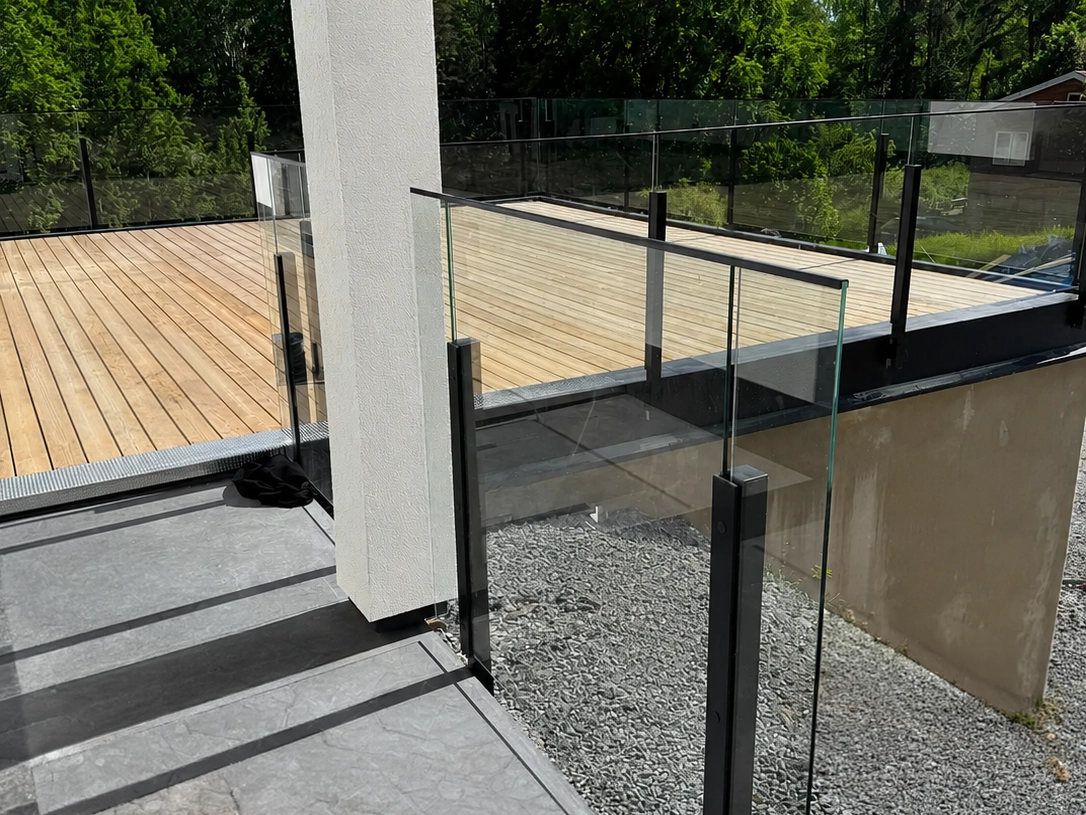
The profiles and fasteners frame the railing. But the glass is what you see, what bears the load, what filters the sun’s rays, what you’ll be cleaning for the next ten years, and what determines whether the railing will still be safe if something hits it. This guide, therefore, is all about one thing: the glass in the glass railing.
We’ll go over the differences between laminated glass, tempered laminated glass, and tempered & laminated glass, and explain why ordinary window glass should never be used in a glass railing. Then we’ll look at the colors—clear, ultra-clear, opal/frosted, gray, and tinted glass—and show how the color is created within the laminate. At the end, you’ll find a buying guide that matches glass to specific situations.
Standard window glass (float glass) is not permitted in a railing. It shatters into large, sharp shards and lacks the strength required for a railing structure. Instead, a type of glass called safety glass is used—glass that is designed to hold together when broken, or to shatter into harmless small pieces.
Three types are most common in railing applications: laminated glass, in which two glass panes are bonded together with a tough PVB interlayer that holds the glass fragments in place in the event of breakage; tempered glass, which has been heat-treated to make it 4–5 times stronger and shatters into small, rounded granules instead of sharp shards; and laminated tempered glass, which combines both—the safest option.
In addition, all the glass we supply has ground and polished edges. This is a quality feature that not only enhances the appearance—it also reduces the risk of cracking at the edges, which are otherwise the glass’s weakest point.
Laminated glass consists of two glass panes, each 4 mm thick, with a 0.76 mm-thick plastic film in the middle—for a total thickness of 8.76 mm. The film (PVB) is what makes the glass safety glass: if something causes the glass to crack, the glass fragments remain held in place by the film instead of falling to the ground.
Laminated glass is safety glass; it reduces noise (the film dampens sound better than single-pane glass), filters out a large portion of UV radiation, comes with ground and polished edges as standard, and retains some strength even when broken—known as “post-breakage strength.”
This is the standard choice for balconies, patios, and garden railings where the glass is held in place between profiles or posts—for example, in a clamp or U-profile. A reliable choice for private residential settings that meets the requirements for most standard fall heights.
Tempered laminated glass is constructed in the same way as standard laminated glass (4 mm + film + 4 mm), but the two glass panes are tempered before they are joined together. Tempering makes the glass 4–5 times stronger and changes the way it breaks—if it breaks, it shatters into thousands of small, rounded granules instead of larger pieces, the same type of breakage you see on a car side window.
The glass can withstand stronger impacts and point loads without cracking, has a greater tolerance for temperature differences (sun/shade, summer/winter), and shatters into granules that are held in place by the film.
We recommend tempered laminated glass in areas where the railing may be subjected to repeated external stress—such as balconies where children run, public spaces, areas exposed to strong winds, sun-exposed facades with significant temperature fluctuations, or simply when you want an extra margin of safety.
Tempered glass must have precise dimensions and polished edges before tempering. After tempering, it cannot be cut, drilled, or sanded without the glass cracking.
That is why tempered laminated glass is a made-to-order product with a slightly longer lead time—each pane is manufactured specifically to your measurements.
12.76 mm tempered and laminated glass is stronger in every dimension: two tempered glass panes, each 6 mm thick, bonded together with a 0.76 mm PVB interlayer. This is the glass we recommend when the design calls for higher standards—for example, a glass railing without handrails, a railing around a pool, or a balcony in a multi-family building with a greater drop height.
Choose 12.76 mm over 8.76 mm for railings where the glass bears a heavier load (e.g., without a top or side profile), for large glass sections between posts, on high balconies, skywalks and rooftop terraces, in commercial spaces (restaurants, offices) where strength requirements are more stringent, near pools and spas where the glass is exposed to moisture and temperature fluctuations, and whenever you want extra safety even if 8.76 mm is approved for the location.
The thicker glass also appears more “substantial” visually—the edge is visibly deeper, a feature that many appreciate in modern railing designs.
| Property | 8.76 mm laminated glass | 8.76 mm tempered laminated glass | 12.76 mm tempered & laminated |
|---|---|---|---|
| Structure | 4 mm + foil + 4 mm | 4 mm tempered glass + film + 4 mm tempered glass | 6 mm tempered glass + film + 6 mm tempered glass |
| Strength | Standard safety glass | 4–5 times stronger than uncured | Strongest – can withstand the most stress |
| Crime Pattern | Cracks, held together by foil | Granules, held in place by foil | Granules, held in place by foil |
| Edge Finishing | Ground & Polished | Ground & Polished | Ground & Polished |
| Suitable for | Balconies, patios, gardens | Challenging locations, higher balconies | Pool, high balcony, commercial |
| Color Options | Clear, ultra-clear, opal, gray, tinted | Clear, ultra-clear, opal, gray, tinted | Clear, ultra-clear, opal, gray, tinted |
| Price (relative) | $ | $$ | $$$ |
Select the glass type, thickness, color, and mounting system in the configurator—you'll see the price and delivery time immediately based on your specific measurements.
Both processes begin in a glass furnace and result in a product tailored to the customer—but the sequence is different, and it is this difference that determines the glass’s properties.
Laminated glass is manufactured in two steps: first, two glass panes are stacked with a plastic film in between, in sizes up to 3000 × 6000 mm, and pressed together under heat and pressure. The film melts between the glass panes to form a tough, transparent bond that permanently joins them. The laminate is then cut and polished to your exact dimensions—this is the step we call “custom-made.”
Tempered glass must be processed before it is tempered, not after. Once the glass is tempered, it cannot be cut, drilled, or sanded without cracking. The process therefore works as follows: first, the glass panes are cut to exact dimensions, and the edges are ground and polished. The panes are then heated to around 620 °C in a tempering furnace and rapidly cooled—the internal stress built up in the glass is what makes it stronger. Finally, the two tempered panes are laminated together with PVB film to form a finished product.
That is why tempered laminated glass is always made to order: each pane is produced specifically to your measurements, and each step must be carried out in the correct order.
The color is created in three different ways, depending on the type of glass. Gray laminated glass consists of gray glass + clear plastic film + gray glass—the color is inherent in the glass itself; the film is transparent and merely holds the structure together. Opal glass consists of transparent glass + white (milky) plastic film + transparent glass—the film is what creates the opal effect; the glass itself is clear. Colored laminated glass consists of transparent glass + 2–4 colored plastic films + transparent glass—depending on the desired color, different numbers of colored films are placed in the middle to achieve the right shade.
Since the color is embedded within the laminate, the glass is just as easy to clean regardless of the color—you can clean it with regular window cleaner without affecting the color.
Clear glass is the standard choice for most glass railings: completely transparent, it allows maximum light to pass through and offers an unobstructed view. The glass has a very faint green tint that is most noticeable at the edge of the glass or when looking through multiple layers of glass—on a standard balcony or patio, it’s barely noticeable.
Clear glass is ideal for balcony railings with views of a garden or residential area, for patios and balconies facing any direction, for indoor applications where a glass railing frames a staircase or a loft, and when budget is a factor—clear glass is the most affordable clear option.
Ultra-clear glass (also known as low-iron glass) has a minimal iron content and lacks the faint green tint found in clear glass. The result is a completely natural rendering of the view, plants, and colors on the other side of the glass. It is the premium glass choice for railings where the view is the main attraction.
Choose ultra-clear when the view is part of the reason you chose a glass railing—ocean views, lakefront property, mountain scenery. This is clearly noticeable on railings where the sun hits the glass in backlighting; the green tint becomes more pronounced there. Ultra-clear is also the obvious choice around pools, especially indoor ones, where color distortion would be distracting, as well as in exclusive settings where you want the most authentic visual experience.
The difference between clear and ultra-clear glass is most noticeable in two situations: when you look at the cross-section of the railing, and when the sun is low in the sky and hits the glass from behind. On a standard balcony without a spectacular view, clear glass is more than sufficient.
For installations near the water or indoor pool railings, however, ultra-clear glass is well worth the price difference—it makes the glass virtually invisible.
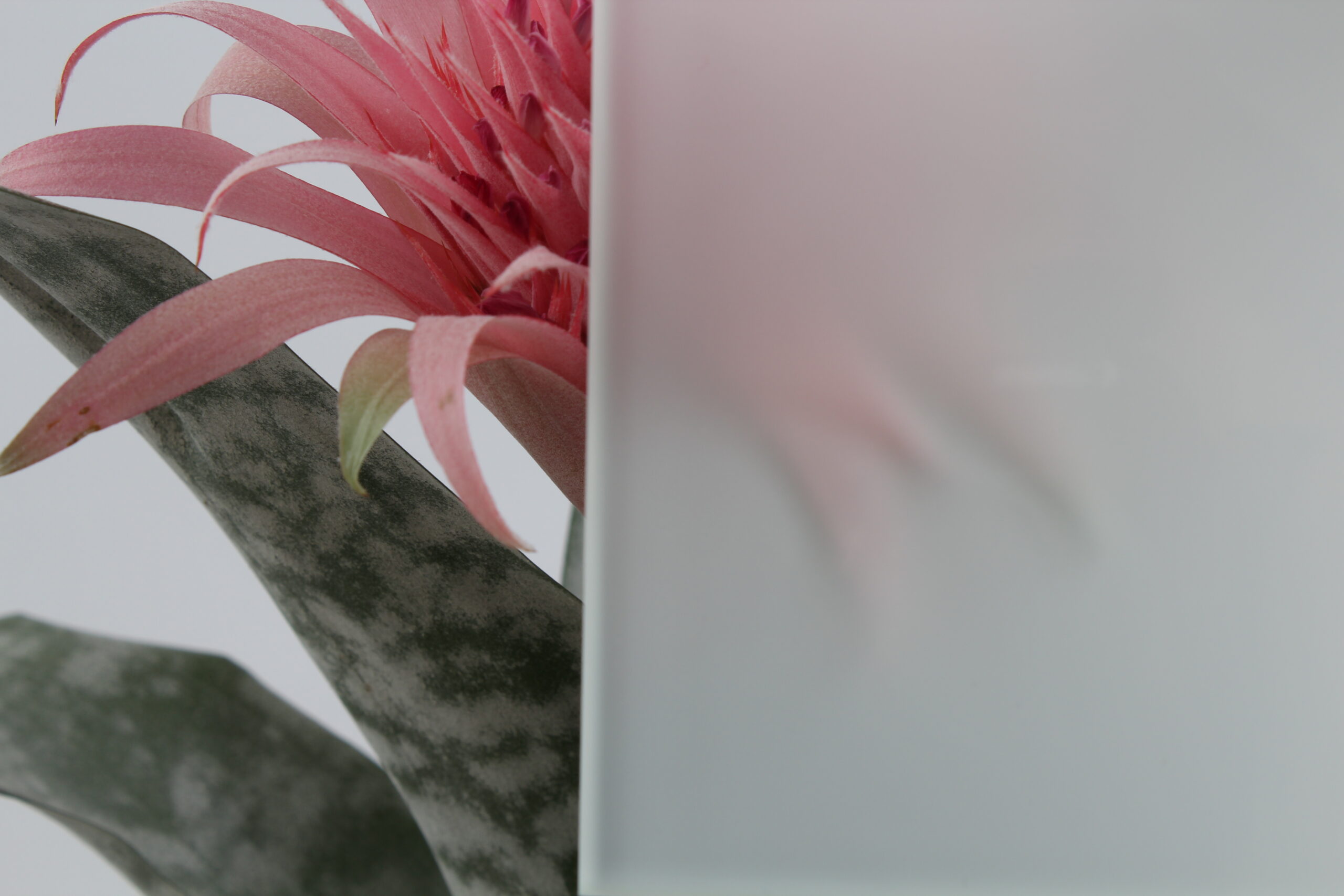
Opal glass consists of a white/milky film laminated between two transparent glass panes. The result is a uniform, matte surface that lets light through but hides details on the other side. Many people refer to this look as “frosted glass”—and in a glass railing, it’s essentially the same thing.
The difference between opal glass and “real” frosted glass: opal glass has a matte finish protected by a film inside the laminate (easy to clean, doesn’t age, and withstands outdoor conditions), while sandblasted or etched “frosted” glass has the matte finish on the surface and can absorb grease, dirt, or water unless it’s specially treated. In a glass railing, you’ll practically always get opal glass—it’s the only type that can withstand the Nordic climate over time.
Choose Opal for balconies that are visible from neighbors’ homes, the street, or a walkway—Opal blocks the line of sight without blocking out the light. It also serves as a windbreak where you want a soft, light-transmitting wall; on patios where you want a backdrop that doesn’t compete with the garden or architecture; in glass-enclosed porches where diffused light is desirable; and in stairwells and lofts where you want to maintain an airy feel while concealing what’s happening on the other side.
Gray glass (smoked glass or tinted glass) is a type of glass in which the glass itself is gray, laminated with a clear film in the middle. You can still see through the glass, but everything on the other side appears slightly darker and more subdued—much like looking through sunglasses.
The advantages are that gray glass reduces glare from the low-angle sun on the balcony or terrace, provides some privacy without completely blocking the view (you can see out, but others can’t see in as well), complements modern facades in gray, black, or anthracite, where clear glass might seem “too invisible,” and hides dirt and fingerprints better than ultra-clear glass.
Gray glass also slightly obscures your own view—it’s not the right choice if the lake or ocean view is the main attraction. It works best where the sun is strong or where privacy is more important than maximum transparency.
If you want to block the sun without losing the view, a combination of clear glass facing the view and gray glass on the sun-facing side may be the solution.
All of our glass is delivered with ground and polished edges. This quality standard is important in two ways.
Aesthetics: The edge is smooth, glossy, and free of micro-chips—the glass looks like a designer product rather than a cut sheet. Technical considerations: Glass is strongest at the surface and weakest at the edge. Microscopic cracks in an unpolished edge can act as starting points for glass breakage. A ground and polished edge minimizes that risk.
In the context of railings, this is especially important because the glass is often exposed with its edge visible—for example, in a clamp mount, a ground-level U-channel, or a point-fixing installation. An unpolished edge would be both visible and a weak point.
All glass from Balustrade Store is delivered with ground and polished edges—this is never an optional extra, but rather part of our quality standard. You don’t pay extra for the edge finishing; it’s included with all our laminated glass, tempered laminated glass, and tempered & laminated glass.
| Type of Glass | Thickness | Delivery Time |
|---|---|---|
| Clear laminated glass | 8.76 mm | Manufactured by us |
| Clear tempered laminated glass | 8.76 / 12.76 mm | Made-to-order item |
| Ultra-clear laminated glass | 8.76 mm | Manufactured by us |
| Ultra-clear tempered laminated glass | 8.76 / 12.76 mm | Made-to-order item |
| Gray laminated glass | 8.76 mm | Manufactured by us |
| Gray tempered laminated glass | 8.76 / 12.76 mm | Made-to-order item |
| Opal laminated glass | 8.76 mm | Manufactured by us |
| Opal tempered laminated glass | 8.76 / 12.76 mm | Made-to-order item |
| Tinted laminated glass | 8.76 mm | Made-to-order item |
| Tinted, tempered laminated glass | 8.76 / 12.76 mm | Made-to-order item |
Glass is one of the easiest materials to care for—but a few tips can make a difference in the long run.
For regular cleaning: use a standard window cleaner and a soft cloth. For tougher stains (tree sap, bird droppings, grease), remove them with rubbing alcohol and a soft cloth. Rinse with clean water afterward and dry with a microfiber cloth to prevent water spots.
Avoid abrasives, steel wool, or scouring pads—they will permanently damage the glass surface. Also, avoid applying harsh chemicals (lye, acids, solvents) to the film along the edges, and do not apply pressure to the edges of the glass, as glass is strongest on the surface and weakest at the edges.
If the glass is held in place by clamps, the screws should be retightened 2–3 times a year during seasonal temperature changes (spring and fall). This ensures that the glass remains securely in place and that the seals maintain the proper pressure.
With proper care, your glass railing will last for many years—the glass does not age, and the color does not fade because it is embedded within the laminate.
Here are our recommendations tailored to common situations:
Please contact our customer service before placing your order—we'll help you choose the right type of glass, thickness, and color for your specific project. You can reach us by phone, chat, or email.
Tempered and laminated glass (12.76 mm) is the strongest option. It combines the strength of tempering with the “holds the glass together upon breakage” property of lamination. For most private balconies, however, 8.76 mm of tempered laminated glass is more than sufficient.
Not very much. Gray glass is tinted—much like light sunglasses. You still have a clear view of the outside, but the sun and glare are reduced. If you want a darker tint or more privacy, opal glass is a better choice.
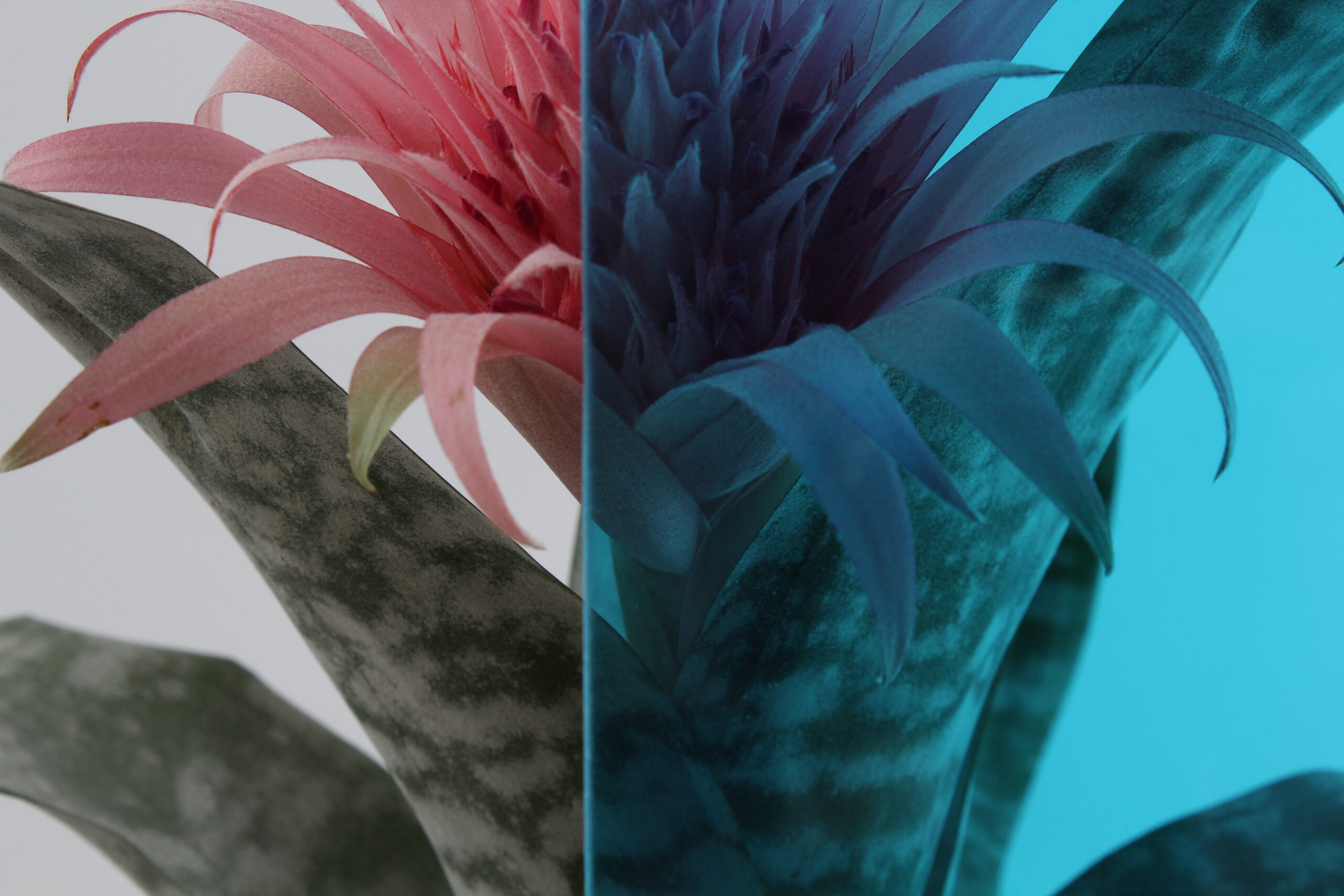
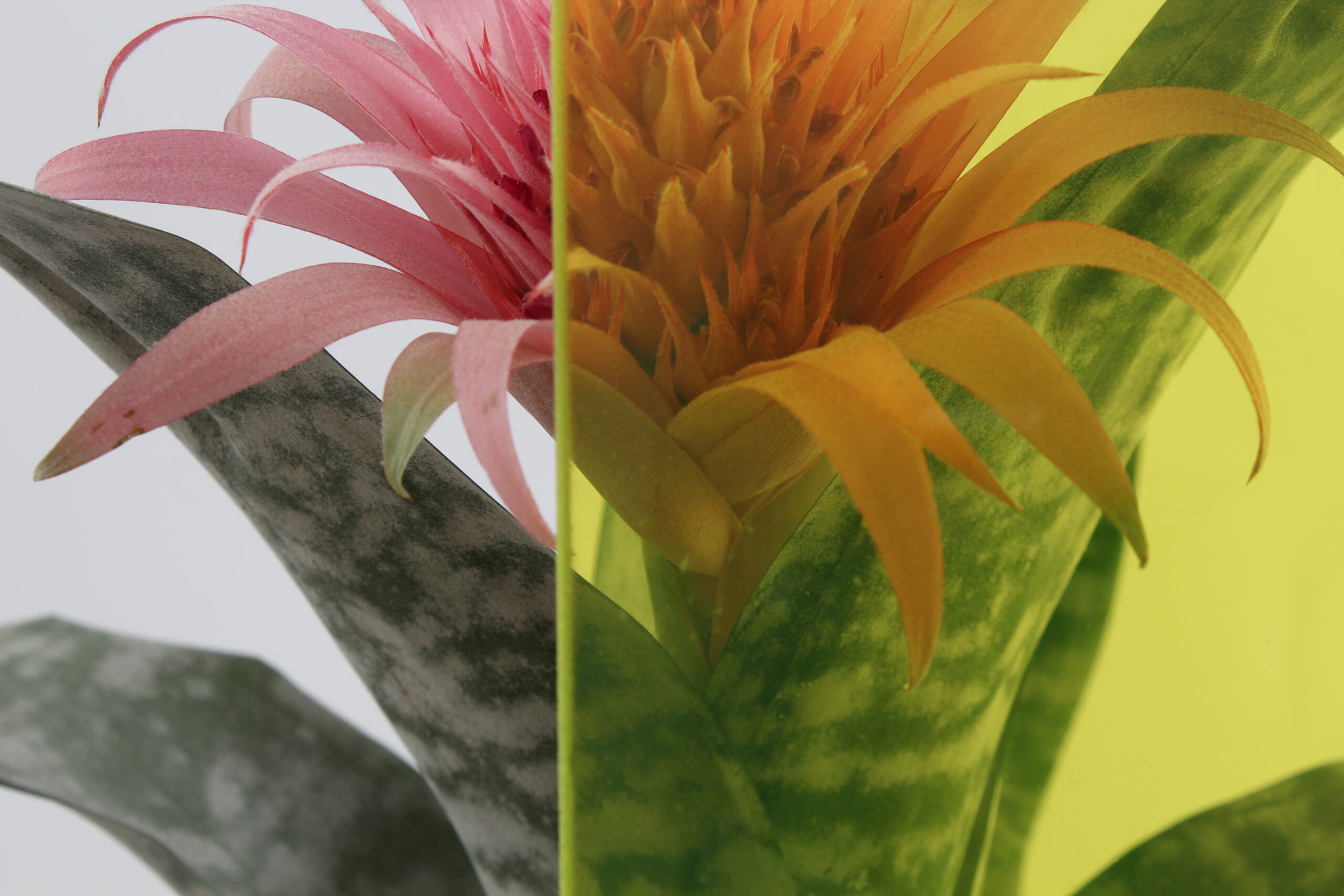
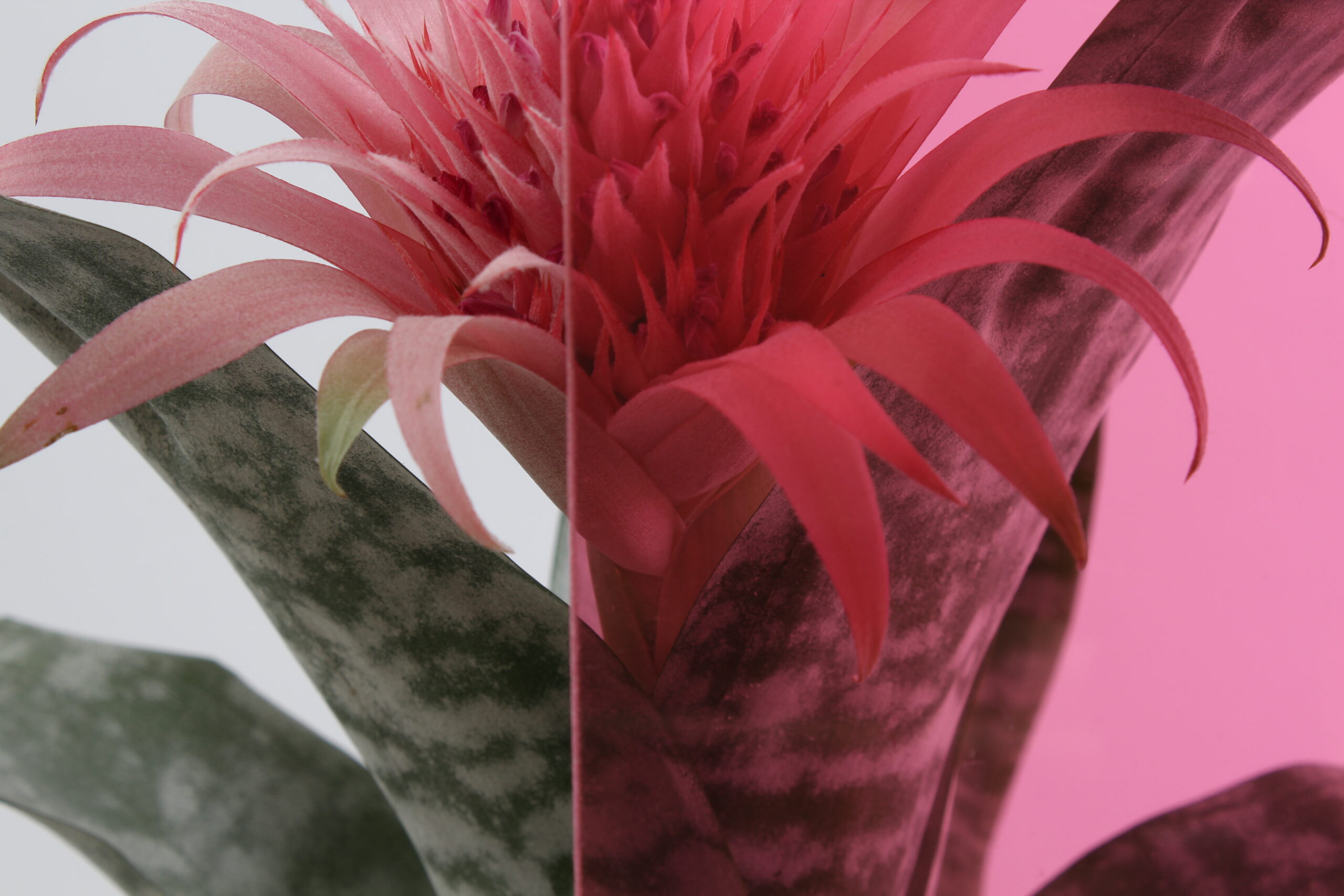
Tinted laminated glass is the most unique option in the product line. The color is created by layering 2–4 colored plastic films between two transparent glass panes—the number of films varies depending on the shade you want to achieve. This means you can essentially order the glass in exactly the shade you desire.
Common applications include design-driven projects where the railing serves as a deliberate architectural element; restaurants, hotels, and offices where the glass reflects a brand’s color palette; art installations and designer staircases; as well as private projects where the railing’s color is precisely matched to the facade—for example, to a Falun red, anthracite gray, or ocean blue facade.
Tinted glass is always made to order, as the color is customized for each order.
Select the glass type, thickness, color, and mounting system in the configurator—you'll see the price and delivery time immediately based on your specific measurements.