logo
0

Your shopping cart is empty

Add products to see them here.

Antal: {{item.quantity}}
Totalsumma:{{cart.totals.total_incl_vat}}
Frakt:{{cart.totals.shipping_cost}}
Att betala:{{cart.totals.total_incl_vat}}
varav moms {{cart.totals.average_vat_rate}}:{{cart.totals.vat_amount}}

The Railing Guide – How to Choose the Right Railing for Your Home, Balcony, and Patio

A railing frames your home, ensures that no one falls, and sets the tone for the entire space’s look. Here’s a complete guide to choosing the right railing—from glass, aluminum, and stainless steel to wrought iron, wood, and wire—plus the Swedish National Board of Housing, Building, and Planning’s height regulations, material choices, and which railing is best suited for each location.

Contents

Table of Contents

The Railing – More Than Just Aesthetics

Choosing a railing is about more than just appearance. The railing should be functional in everyday life, feel safe to use, and fit the space where it will be installed. On a high deck, fall protection is the top priority. On a patio close to the ground, it’s more about framing the space or providing shelter. On a staircase or in a loft, the user’s grip and safety are the most important factors.

This railing guide is our comprehensive overview of all railing types, materials, and settings—designed to be the first step in your decision-making process. Once you’ve decided on the type of railing you want, we’ll direct you to our in-depth guides for glass railings, patio railings, stair railings, and balcony railings. That way, you’ll get the big picture here and the details you need there.

We’ll go over the five most common types of railings, the environments they’re best suited for, what the Swedish National Board of Housing, Building, and Planning’s (Boverket) building regulations (BBR) say about height and safety, how railings are installed and maintained, and how to take your project from the initial idea to a fully installed railing.

Quick Answer – Which railing fits where?

  • Glass railing —when you want to enjoy the view and stay sheltered from the wind all at once.
  • Aluminum railing – when you want minimal maintenance and a choice of colors.
  • Stainless steel railing —for a timeless, sturdy look and a coastal atmosphere.
  • Wrought iron or wood —for traditional homes and classic architecture.
  • Wire railing – when you want a discreet boundary without blocking the view of your surroundings.

An Overview of the Five Most Common Types of Railings

There are five predominant types of railings on the Swedish market: glass railings, aluminum railings, stainless steel railings, wrought iron or wooden railings, and cable railings. Each has its strengths and weaknesses, and the choice is guided by three factors: the style of the house or location, the environment where the railing will be installed (sun, wind, salt, wear and tear), and how much maintenance you’re willing to put in over time.
  • Glass railings are the modern favorite for patios, terraces, balconies, and staircases with a view—because the glass preserves the line of sight while also serving as a windbreak.
  • Aluminum railings have gained popularity in recent years thanks to their low maintenance requirements and available RAL colors.
  • Stainless-steel railings have become the standard in modern functionalist settings and in coastal locations where the salt content in the air places demands on the material.
  • Wrought iron and wood live on in their classic forms—often in turn-of-the-century homes, farm cottages, and houses with traditional architecture, where a glass railing would stand out too much.
  • Wire railings are the narrowest niche: a very unobtrusive design that takes up minimal visual space, but with restrictions under the BBR in areas where children are present.
In the following three sections, we’ll take a detailed look at the three most popular types of railings. We’ll return to the topics of wood, wrought iron, and wire in Section 8.

Glass railing – light, views, and wind protection all in one

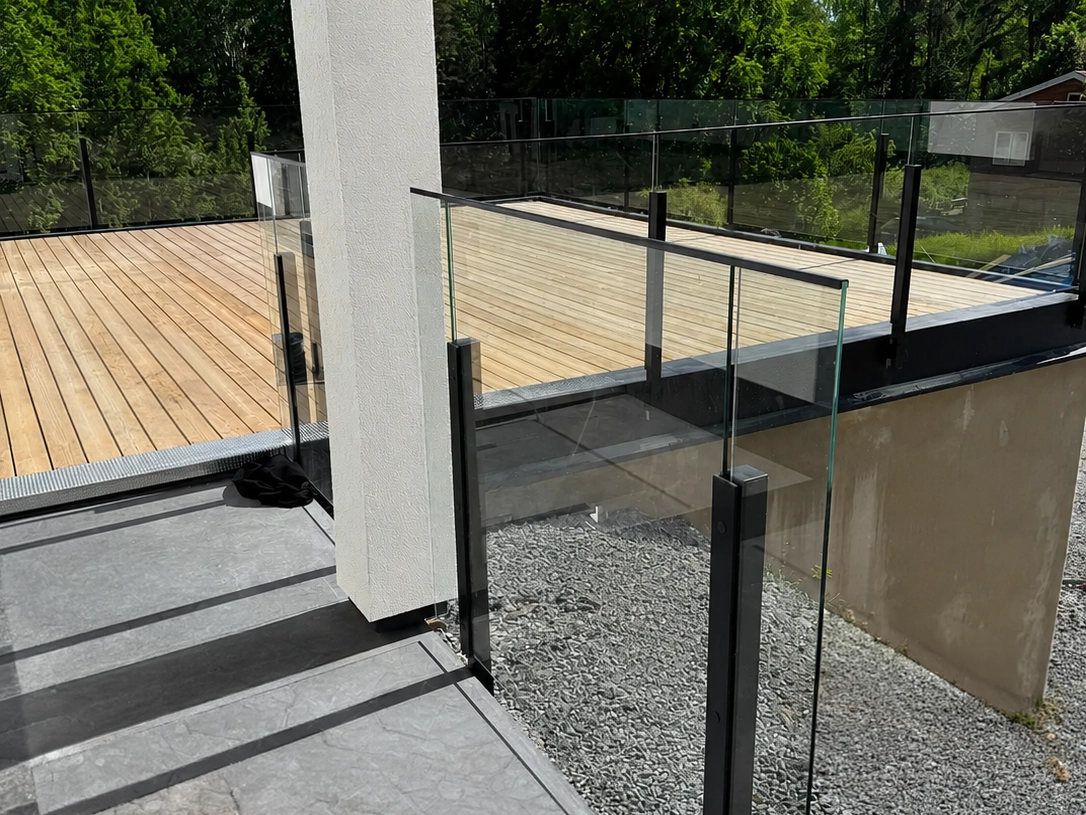
Glass railings are often the obvious choice when you want to preserve the view. The glass is smooth and solid, which also makes it an effective windbreak—and, in opal or frosted finishes, it provides privacy from neighbors and passersby.

According to the Swedish National Board of Housing, Building, and Planning’s building codes, the glass in a railing must be safety-rated (laminated) to meet the requirements for greater drop heights, so that no one risks falling through if the glass breaks. The most common types are 8.76 mm laminated glass (standard for residential environments), 8.76 mm tempered laminated glass (for exposed locations), and 12.76 mm tempered and laminated glass (for French balconies, high balconies, pools, or commercial environments).

You can choose between clear, ultra-clear, opal (frosted), gray, or tinted glass, depending on your view and privacy needs. If you’d like to learn more about the different glass options and their technical differences, we have a more detailed guide to glass for glass railings that takes an in-depth look at each type of glass.

Aluminum railing – minimal maintenance and a choice of colors

Aluminum is one of the easiest materials to maintain on the market for railings. It is naturally corrosion-resistant, which means it can withstand moisture and the Nordic climate without rusting. It is a durable option that can be powder-coated in any RAL color—popular choices include white (RAL 9010), gray (RAL 9006), black (RAL 9005), and anthracite (RAL 7016)—to match the color of your home’s exterior or window frames.

Aluminum railings are lighter than stainless steel and easier to handle during installation. They are suitable for both outdoor (patio, balcony, terrace) and indoor (stairs, loft) use and are often combined with glass, wire, or vertical slats as infill material. Maintenance basically consists of wiping them down with lukewarm water 1–2 times a year—no rust treatment, no repainting.

Things to Know About Aluminum

Powder-coated aluminum lasts for many years, but the coating can be damaged by hard impacts—which can allow moisture to penetrate and cause the coating to peel. Never use solvents such as paint thinner or acetone when cleaning; they damage the coated surface.

Anodized aluminum has a self-protective oxide layer instead of paint and can therefore withstand more mechanical wear.

Stainless Steel Handrail – Timeless and Sturdy

Stainless steel is often used when you want a sturdy construction with a technical and modern look. It works well both indoors and outdoors, and becomes a natural part of a functionalist building, a newly built single-family home, or an industrial building. Despite its name, stainless steel is not completely resistant to corrosion—and for outdoor use, it is crucial to choose acid-resistant steel (AISI 316) to prevent surface rust. This is especially important in coastal areas or environments where the air has a high salt content or high levels of pollution.

Stainless steel railings are often combined with glass, wire, or flat bar material as infills. The posts can be topped with a cap made of the same material or a wooden crossbar for a softer feel against the hand. Maintenance consists of 1–3 wipe-downs per year with lukewarm water and a mild detergent—more frequently in coastal locations.

In our designs, we use AISI 316 acid-resistant stainless steel as the standard for all outdoor products, and AISI 304 for indoor applications where the air environment is more controlled.

Quick Comparison: Glass Railings · Aluminum Railings · Stainless Steel Railings

Here you'll see the three most common types of railings side by side, along with their key features, so you can quickly determine which type best suits your environment and priorities.
PropertyGlass railingAluminum railingStainless steel railing
MaintenanceLow – cleaning onlyVery lowLow – wiping 1–3 times a year
Color OptionsClear, opal, gray, coloredAll RAL colorsNatural steel tone
Suitable for outdoor useYes—everything about the climateYes – including coastal areasYes, AISI 316 in coastal areas
Suitable for indoor useYes – staircase, loftYes – modern styleYes – industrial style
WindshieldsYes—effectiveDepends on the infillDepends on the infill
Privacy screensYes – with opal or gray glassDepends on the infillDepends on the infill
AestheticsModern, airyModern, customizableTechnical, timeless
Design your railing right away

Select the railing type, height, material, and mounting system in the configurator—you'll see the price and delivery time immediately based on your measurements.

View all railings →

How to Install a Railing—Frame, Brackets, and Mounting

The railing is subjected to significant forces, both from wind pressure and from people leaning against it. It is therefore crucial that the mounting is properly sized for the substrate—a stylish railing that is installed incorrectly will not hold up over time, no matter how beautiful the glass or posts are.

There are three main principles for installation. When installing on wood (decking, wooden joists), screws must always be fastened into load-bearing studs, not just into the decking—the decking does not provide sufficient grip to support the railing’s load. In concrete or other hard surfaces, chemical anchors or expansion anchors are used, sized according to the railing’s weight and the horizontal forces to which the structure is subjected.

A stainless-steel railing with a round handrail and a post in front of a green hedge.
Stainless steel handrail with round handrail bar

The second option is the fastening system for the infill material itself (the glass, slats, or wires). Clamp fasteners are the most common choice for glass railings—small stainless steel or aluminum clamps that secure the glass at specific points to the post or joist. Profile glass (U-profile at ground level) creates a fully glazed solution with no visible posts. The slotted post system is the classic design, where the posts support a top rail and hold the infill in place between them.

The third choice is the mounting type: top mounting (the posts extend straight up from the subfloor) or side mounting (the posts are attached to the side of the joists). Top mounting is easiest on a deck or rooftop terrace; side mounting is used where the floor surface needs to be completely level or where height needs to be maximized without sacrificing floor space. Both are approved; the choice is often based on aesthetics and practicality.

Wood, wrought iron, and wire—more material options

In addition to glass, aluminum, and stainless steel, there are three materials that remain firmly established in specific settings: wood, wrought iron, and wire. Each has its own aesthetic and its place in the Swedish railing landscape.

Wood is the classic choice—pressure-treated pine, larch heartwood, or oak are used both for the railing posts and as crossbars/handrails. Wood ages beautifully if treated properly, requires more maintenance than metal (it should be oiled or stained every 2–4 years when used outdoors), and is particularly well-suited for turn-of-the-century homes, farmhouses, and country-style homes. Wood is also often used to provide a soft grip in the form of a handrail atop an aluminum or stainless steel railing.

A stainless steel wire railing installed on a staircase next to a yellow wooden house with flowers.
Stainless steel wire railing mounted on a staircase

Wrought iron is the second traditional material, often seen on turn-of-the-century buildings, manor house balconies, and in classic stairwells. Wrought iron requires surface treatment (galvanization or powder coating) to prevent rust, and should be inspected every few years to catch rust before it spreads. Its aesthetic is decorative and artisanal—it doesn’t suit modern minimalist styles, but it’s perfect for traditional architecture.

Wire Railing It is the slimmest and most discreet option. The cables are stretched horizontally between posts, creating an almost invisible barrier—perfect for terraces with a view or in modern indoor settings such as lofts and industrial apartments. Keep in mind, however, that wire constructions may be classified as climbable according to BBR—they are not suitable as fall protection in environments where children under 12 are present, since children can climb the horizontal wires. If you want the aesthetic of wire fencing in a child-safe environment, the wires must be stretched vertically or combined with a solid lower section.

Indoor railings – stairs, lofts, and mezzanines

Indoor railings serve a slightly different purpose than outdoor ones. Since they are not exposed to harsh weather conditions, the choice of material is determined almost entirely by aesthetics and ergonomic grip. Glass railings are popular in modern single-family homes and townhouses because they open up the space and allow light to pass between floors. Aluminum and stainless steel work just as well indoors, often with a wooden handrail for a softer grip.

On a staircase, the handrail serves primarily as a support—your hand rests on it as you go up or down. This means that the shape, diameter, and material of the handrail affect the feel more than anything else. A round wooden rail measuring 38–45 mm is a classic size that fits most hands, while a flat top made of stainless steel or aluminum gives a more modern look but may feel harder to the touch.

For lofts, mezzanines, and indoor balconies, the railing is considered a fall protection measure. According to the Swedish National Board of Housing, Building and Planning (Boverket), the same minimum dimensions apply here as for outdoor areas: at least 900 mm for a fall height ≤3 m, and at least 1,100 mm for a fall height >3 m. No openings may exceed 100 mm in areas where children under 12 years of age are present. Stair and landing railings must be at least 900 mm high.

For more information on handrails specifically for stairs—including slope adjustments, glass panels for stairs, and handrail dimensions— you can read our stair guide here.

Outdoor Railings – Deck, Balcony, and Patio

Outdoor railings are the largest category—and the one where the choice of material matters most. Sun, rain, wind, snow, and frost impose demands that indoor environments never do. That is why stainless steel, aluminum, and glass dominate the outdoor market today, with wood and wrought iron as strong traditional alternatives.

On the balcony, the railing serves as a fall protection, windbreak, and design element all in one. Glass railings are often the preferred choice because they preserve the view, act as a windbreak, and require minimal maintenance. Wooden fences or vertical slats made of pressure-treated wood are the classic and more affordable option. For more detailed information about railings and fences specifically for patios, read our patio guide, which covers placement, size, regulations, and inspiration.

On balconies in apartment buildings, additional considerations apply: the homeowners’ association’s bylaws, the uniformity of the building’s facade, and the board’s approval. A railing is often considered a facade alteration and requires approval from the board before ordering. An opal-finish glass railing is one of the most popular solutions for balconies because it provides both privacy from neighbors and wind protection in a single design. A dedicated balcony guide will be available soon, featuring in-depth information on balcony railings and French balconies.

According to the Swedish National Board of Housing, Building, and Planning, a railing along a ground-level patio is not normally required (a railing is not required for drop heights under 0.5 m). In this case, the structure is often a fence—more a design choice than a safety requirement—and you have a great deal of freedom in its design.

Tips from Us

If you want to combine multiple functions in a single outdoor railing—fall protection, wind protection, and privacy—a glass railing in an opal or gray finish is often the simplest solution. You get all three in one design without needing separate windbreaks or panels.

For coastal installations: always request acid-resistant stainless steel (AISI 316) or powder-coated aluminum. Standard stainless steel (AISI 304) is not sufficient in salty air.

Railings in Public and Commercial Settings

In public and commercial settings—hotels, restaurants, offices, apartment buildings, shopping malls, hospitals, and schools—the requirements for handrails are more stringent than in private homes. The load-bearing requirements are higher, the choice of materials is more limited, and the wear and tear is more severe.

For commercial environments, we always recommend 12.76 mm tempered and laminated glass that provides fall protection, as it can withstand significantly higher point loads. The posts should be made of acid-resistant stainless steel (AISI 316) or heavily reinforced powder-coated aluminum. Wood and wrought iron solutions are more common in older, historically protected buildings where the original style must be preserved during renovation.

In public spaces, stricter safety requirements from the Swedish National Board of Housing, Building, and Planning (Boverket) also apply: the railing height is often 1,100 mm even at lower fall heights, and the structure must be able to withstand the load that occurs when many people lean against the railing at the same time—for example, at an outdoor dining area or on a hotel balcony. In these cases, documentation and a declaration of performance are essential for meeting the industry’s strength requirements.

For large-scale construction projects and corporate orders, we offer 3D/BIM design, project cost estimates, and coordination with the general contractor. Please contact our corporate department for inquiries.

Railings in coastal and exposed locations

Railings in coastal areas or exposed high-altitude locations are subjected to significantly harsher conditions than railings on an inland home. Salt, moisture, wind, and extreme temperature fluctuations place heavy demands on the material—and the wrong choice can cause the railing to start rusting within a few years.

The first critical choice is the grade of stainless steel: AISI 304 (standard stainless steel) is not sufficient in a coastal environment. It must be AISI 316 (acid-resistant stainless steel), which can withstand chloride-rich air without developing surface rust. Powder-coated aluminum also works excellently in coastal environments—aluminum does not oxidize, and the coating protects the surface.

The second choice is the thickness of the glass. On an exposed balcony or rooftop terrace where the wind blows hard, we recommend 12.76 mm of tempered and laminated glass, along with sturdy fastenings to the joists. 8.76 mm works in more sheltered locations but is not as safe under extreme wind loads.

Wind Loads on Fully Glazed Railings

A glass railing that covers large areas without openings is subject to significant wind loads—especially on higher-level balconies and in coastal locations. Undersized structures risk coming loose or toppling over in strong winds.

Railing Height and Regulations According to the Swedish National Board of Housing, Building, and Planning (BBR)

Railings are safety devices and are therefore regulated by the Swedish National Board of Housing, Building, and Planning’s building regulations (BBR). Here are the most important rules you need to know, regardless of the type of railing you choose:

  • Handrail Height: According to BBR, safety handrails must be at least 900 mm high for a normal fall height (up to 3 meters) and at least 1,100 mm high for a fall height exceeding 3 meters. For stairs and landings, the minimum height is 900 mm. In public spaces, apartment buildings, and public facilities, the 1,100 mm requirement often applies even at lower fall heights.
  • Openings in the railing: No vertical openings may exceed 100 mm in areas where children under 12 years of age may be present. This applies to spaces between vertical rails, between glass panels, between the bottom edge of the railing and the floor joists—and all other gaps in the structure.
  • Climbability: The railing must be designed so that children under 12 years of age cannot climb over it. Railings with horizontal slats or wires in areas where children are present may be deemed climbable by the municipality and, in such cases, must be modified or raised.
  • Load: The railing must be able to withstand a horizontal load equivalent to that of an adult leaning against it. Higher load requirements apply in public settings. For glass railings, tempered or toughened and laminated glass is used, with the glass serving as the primary fall protection.
  • Building Permit: In most cases, no building permit is required to replace the railing on an existing single-family home. For new patios, balconies, or major changes to the property’s character (such as adding glass enclosures or tall fences), a building permit may be required. Special rules apply within zoning plans with specific provisions, in culturally protected areas, or on properties designated as historic landmarks—always check with the municipal building board.

Keep in mind that the National Board of Housing, Building, and Planning’s building codes are updated periodically—always check the latest version on the Board’s website if you are unsure.

Delivery and Manufacturing—What Factors Affect the Time from Order to Delivery?

The delivery time for a railing depends on the railing type, dimensions, material, glass selection, color, mounting method, and any optional features. Since all of our railings are manufactured or customized for each project, the time from order to delivery may vary. The table below provides a general overview of the factors that typically affect manufacturing and delivery for different types of railings.

When you configure your railing, you'll get a more accurate estimate of the price and delivery time, based on your measurements and selections.

Railing TypeWhat factors affect manufacturing?What factors affect when an order can be delivered?
Glass railing with postsDimensions, glass type, number of glass panels, posts, clamps, and any crossbeamsProject scope, selected materials, and current production schedule
Post-free glass railingGlass thickness, mounting method, length, corners, and any special dimensionsSelection of glass, hardware, or tracks, as well as when all parts of the order are ready
Aluminum railingHeight, length, color options, mounting, handrails, and choice of filling, such as glass or wireCustom sizing, color selection, number of parts, and current order volume
Stainless steel railingMaterial quality, posts, handrails, glass or other infill, and the project's designProduct selection, customizations, availability, and when the entire order is ready for consolidated delivery
Wire RailingLength, number of posts, wire installation, corners, mounting, and any crossbeamsProject dimensions, number of components, and any optional extras
Wrought-iron-inspired aluminum railingDimensions, model, color, gates, and any special modificationsSelected design, surface treatment, scope of the project, and current production
Fittings, Clamps, and AccessoriesSelection of fasteners, materials, color, and compatibility with the railing typeIf the accessories are part of a larger order, they will be shipped together with the other items once everything is ready

Maintenance and Care by Material

How often you need to maintain the railing depends entirely on the material you choose. A glass railing requires virtually no maintenance beyond window cleaning, while an outdoor wooden railing needs to be oiled or treated with wood stain regularly.

  • Glass railing: Clean the glass surfaces with regular window cleaner and a soft cloth. Never use abrasive cleaners or strong chemicals on the glass. The clamps should be retightened 2–3 times a year during temperature changes (spring and fall)—this is one of the main reasons glass railings remain secure for many years.
  • Aluminum railing: Wipe down with lukewarm water and a mild detergent 1–2 times a year. Never use solvents such as paint thinner, acetone, acids, or alkaline agents—they damage the finish. For oil or wax stains, a small amount of acetone may be used.
  • Stainless steel railing: Wipe down with lukewarm water and a mild detergent 1–3 times a year, more often in coastal environments. Do not use abrasives, steel wool, or metal brushes—they scratch the surface and impair the material’s corrosion protection. Always remove metal particles from non-stainless steel products promptly if they come into contact with stainless steel components.
  • Wood and wrought iron: Inspect the surface before each season. Wood needs to be oiled or treated with wood stain every 2–4 years when used outdoors, and more frequently in exposed areas. Wrought iron should be inspected for rust and treated before the rust spreads—repowder coating every 10–15 years is standard for outdoor use.

General Inspection: Regardless of the material, check all screws and fasteners at least once a year, preferably before the season begins. This is the single most important maintenance step to ensure that the railing retains its safety function.

Maintenance Tips: Start the Season Off Right

Inspect the railing after winter: make sure all screws are tight, the posts are secure, and the fasteners in the joists haven’t given way. For glass railings: retighten the clamps before you start serving outdoors—that way, you won’t have to deal with loose fittings in the middle of summer.

With proper care, a well-chosen railing will last 20–40 years, depending on the material.

Buying Guide – How to Choose and Order the Right Handrail

Once you've gone through the guide above, you'll have everything you need to make an informed decision. Here's the process, from idea to fully installed railing:

  1. Define the site's needs: Is it fall protection, wind protection, privacy, design elements—or a combination?
  2. Measure the location where the railing will be installed —total length, height from the mounting surface to the desired railing height, and the drop height down to the level below (this will determine whether you need 900 or 1,100 mm, according to BBR).
  3. Choose the type of railing based on the environment: glass railings for views and wind protection; aluminum for minimal maintenance; stainless steel for a timeless design and coastal locations; wood or wrought iron for a traditional style; and wire for a discreet boundary (not in areas with children).
  4. Choose mounting systems and mullions: glass clamps, mullion systems with top rails for traditional designs, and laminated glass for fully glazed solutions without mullions.
  5. Choose a crossbar or handrail, if applicable: stainless steel, aluminum, or wood (oak, pine), depending on style and grip.
  6. Configure and order a custom-sized railing using our configurator—you'll see the price and delivery time immediately based on your measurements.
  7. Assemble according to the instructions included with your order, or book our installation service.
  8. If you maintain the railing according to the instructions in Section 15, it will last for many years.

For specific environments, you can find our other guides here.

Not sure which railing is right for your space?

Please contact our customer service before placing your order—we’ll help you choose the right type of railing, height, and material based on the location, regulations, and your preferences. You can reach us by phone, chat, or email.

Contact Customer Service →

Frequently Asked Questions About Railings

Here you'll find answers to the most common questions about railings, regardless of material or environment. If you can't find the answer you're looking for, please feel free to contact our customer service.

What height does the National Board of Housing, Building, and Planning require?

The Swedish National Board of Housing, Building and Planning (BBR) requires a railing height of at least 900 mm for drop heights up to 3 meters, and at least 1,100 mm for drop heights over 3 meters. Railing heights for stairs and landings must be at least 900 mm. In public spaces and apartment buildings, a height of 1,100 mm is often required even for lower drop heights.
A railing is required when there is a risk of injury from a fall—industry practice dictates that a railing must be installed when the fall height exceeds 0.5 meters. For ground-level patios or balconies without an elevation, a railing is not required, but may still be desirable for aesthetic reasons or to provide privacy.
Glass railings, aluminum railings, and stainless steel railings are the three most common outdoor options thanks to their resistance to wind and weather. In coastal environments, acid-resistant stainless steel (AISI 316) or powder-coated aluminum is recommended to withstand the salt in the air.
Aluminum railings require the least maintenance—just wiping them down with lukewarm water 1–2 times a year. Glass railings come in second: cleaning the glass and wiping down the stainless steel parts 1–3 times a year. Wood and wrought iron require the most care.
AISI 304 is “standard” stainless steel—it works well indoors and in sheltered outdoor environments. AISI 316 is acid-resistant stainless steel with added molybdenum, which makes it significantly more resistant to chlorides (salt). In coastal environments, near pools, or in industrial settings involving chemicals, you should always choose AISI 316.
In most cases, no building permit is required to replace the railing on an existing single-family home. However, if the replacement results in a significant change to the property’s character (such as enclosing a patio with glass or replacing a low fence with a tall picket fence), a permit may be required. Different rules may apply in areas subject to a detailed zoning plan with specific provisions or in culturally protected areas—always check with the municipal building board.
Functionally, they are the same—both are the top part of the railing where you can rest your hand. “Handrails” are primarily used for railings along stairs where the grip serves a functional purpose. “Top rails” are used more generally for railings on patios, balconies, and similar areas where the top rail visually frames the railing. Both can be made of wood, stainless steel, or aluminum.
The railing is installed either as a top-mounted railing (the posts extend straight up from the floor joists) or as a side-mounted railing (the posts are attached to the side of the floor joists). When installing in wood, the screws must always be fastened into load-bearing studs, not just into the decking. In concrete, chemical anchors or expanding anchors are used, sized according to the weight of the railing and the wind load.

Yes, many railings are suitable for do-it-yourself installation—especially glass railings with clamps and pre-assembled post systems. You purchase custom-sized parts from us and install them according to the instructions. For complex installations (high balconies, rooftop terraces, French balconies, commercial settings), we recommend our installation service or a qualified installer.

Supervisors and Mentors – That Little Extra Something

The details of a railing are often what determine its overall impression—and the top rail is the railing’s most important detail. It’s always visible; it’s where your hand rests; and its material and shape determine whether the railing feels elegant or merely functional.

A wooden crossbarmade of oak, pine, or another hardwood—gives the railing a warmer look and a soft, pleasant feel to the touch. Outdoor wood needs to be treated regularly with wood oil and lightly sanded with fine-grit sandpaper in the direction of the grain if the surface has become gray or fibrous. There’s one additional thing to keep in mind for oak crossbars: oak contains tannic acid that can leach out when first exposed to water and discolor underlying surfaces—oil the wood or apply oxalic acid during installation to mitigate this.

A stainless steel or aluminum handrail offers a sleek, modern look and requires minimal maintenance. It works both indoors and outdoors and can be combined with glass, cable, or vertical slats as infills. Flat tops feel colder to the touch than rounded ones—if you want a better grip without sacrificing the modern look, choose an oval or half-round profile instead of a completely flat one.

For handrails along a staircase, the handrail itself is particularly important. A round wooden handrail with a diameter of 38–45 mm is a classic size that fits most hands. Legally, handrails on public staircases must be between 32 and 65 mm in diameter and positioned so that they can be grasped all the way around. Private staircases are not subject to the same regulations, but the same dimensions are ergonomically comfortable.

Adding a wooden top rail or handrail on top of an aluminum or stainless steel railing is one of the most common upgrades our customers make—it gives the railing a unique look and a sense of craftsmanship without sacrificing the low-maintenance nature of metal.

Complete your railing with the right crossbar

In our configurator, you can choose from a variety of top rails and handrails made of stainless steel, aluminum, and wood—all custom-sized to fit the length and corners of your railing. If you’d like advice on which size is best for your space, please contact our customer service team.

Design Your Railing →

Get free personal assistance

Test

Environments
Products