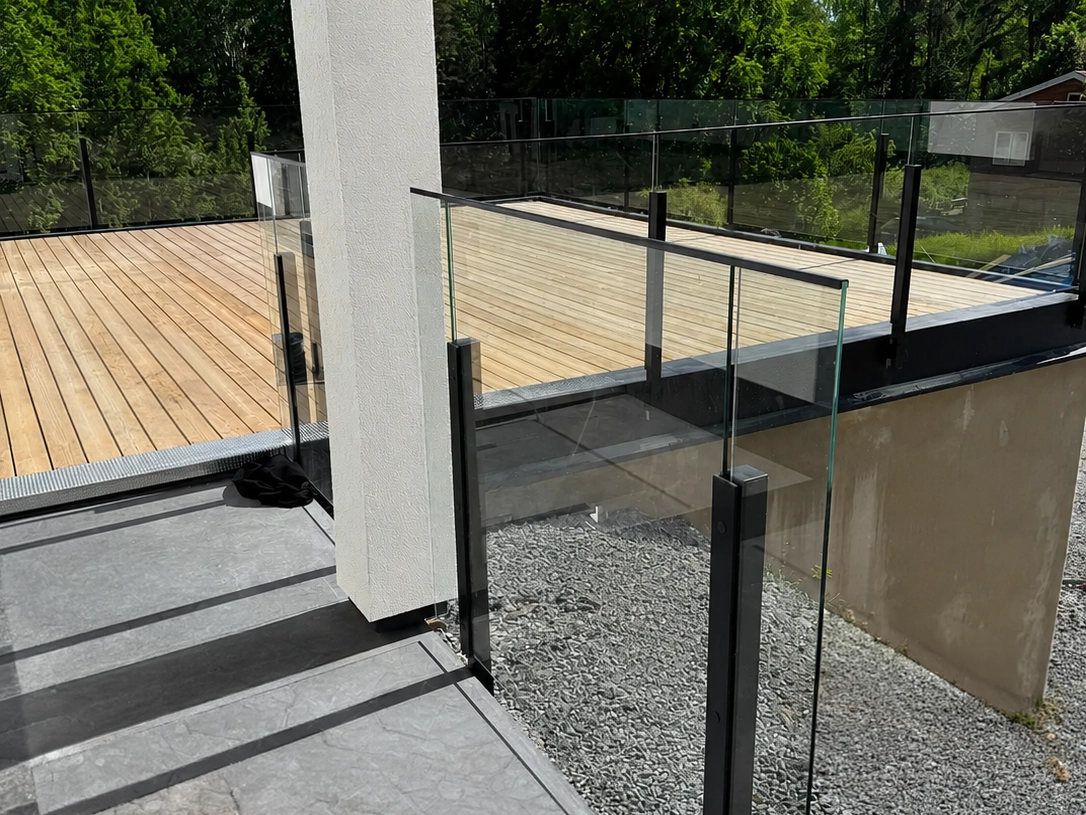
The starting point: a wooden deck that needed a framework
A wooden deck with space for a dining set, flowers, and a lush garden all around. The patio was already well-planned—but the edge facing the garden needed a railing that would provide protection without compromising the sense of space. This is a classic challenge with patios: the railing is critical for safety at that height, yet it risks enclosing a space that is otherwise meant to be open.
A balcony railing serves two purposes: it prevents falls and enhances the character of the outdoor space. A solid plank blocks the view. A dense wrought-iron railing looks heavy against the wood. A stainless-steel railing with glass and wooden crossbars solves both problems in a single solution—and that’s what we chose for this project.
The Solution: Prime railing with wooden crossbars and laminated glass
The railing is our Prime glass railing, featuring posts made of acid-resistant stainless steel (AISI 316), laminated safety glass, and a top rail made of warm-toned wood that matches the floor. The posts are top-mounted on the upper surface of the wooden deck, and the glass is held in place with clamps that create a clean visual line when viewed from the side.
The wooden crossbar is the element that connects the railing to the deck. Instead of introducing a third material—aluminum on top of stainless steel and glass—the railing extends the wood-like feel of the floor all the way to its own top edge. The result is a railing that frames the deck without appearing to be “attached.”
Outdoor wood develops a natural patina over the years. By combining wood with stainless steel and glass, you get a deck where the wood can age naturally—while the structure and safety remain unchanged. Treat the wooden crossbeams with oil once a year to keep the color even.
Glass railings, balusters, or wire—which should you choose?
When it comes to a balcony railing, the choice of infill has the greatest impact on its overall look. Here’s how the three most common options compare
| Railing Type | Visibility & Light | Windshields | Best suited for |
|---|---|---|---|
| Stainless steel glass railing | Complete transparency | Complete | Balcony with a view, locations exposed to the wind |
| Wire Railing | Maximum transparency | None | Balcony with an unobstructed view |
| Horizontal bars | Partially open | Partially | Balcony requiring privacy |
Planning a Balcony Railing – Step by Step
- Measure the edge of the deck and note the corners and any stairs.
- Determine the fall height and, consequently, the minimum height of the railing in accordance with Boverket.
- Choose the filling based on your needs—glass for wind protection, wire for visibility, and slats for privacy.
- Choose the material for the threshold—aluminum, stainless steel, or wood—based on how it will complement the floor.
- Top mounting or side mounting? Top mounting is easier on a wooden deck.
Wood Decking Meets a Stainless Steel Frame—Why This Combination Holds Up
Building a wooden patio railing with a stainless steel frame is one of the most durable combinations for the Nordic climate. The wooden deck is a living material that moves and ages with the seasons—it expands slightly in the heat and contracts in the cold. Stainless steel is dimensionally stable and accommodates these small movements without coming loose or cracking at the fastenings. The result is a railing that adapts to the terrace’s natural movement without requiring readjustment.
Acid-resistant stainless steel (AISI 316) can also withstand outdoor conditions that older railings made of galvanized steel or painted metal often could not. It does not rust along fasteners where the paint peels, it does not leave streaks on the floor, and it retains its matte, brushed finish for decades. For the patio as a whole, this means that the railing will continue to look fresh even as the floor begins to develop its patina.
Certified Manufacturing
Our manufacturing is certified by RISE in accordance with EN 1090-1:2009+A1:2011—the harmonized standard for load-bearing steel and aluminum structures. The railing complies with the Swedish National Board of Housing, Building and Planning’s building codes for railings, with a fall height of over one meter and no openings wider than 100 mm. This means that the railing not only looks good—it is also dimensioned and tested to withstand actual fall protection loads.