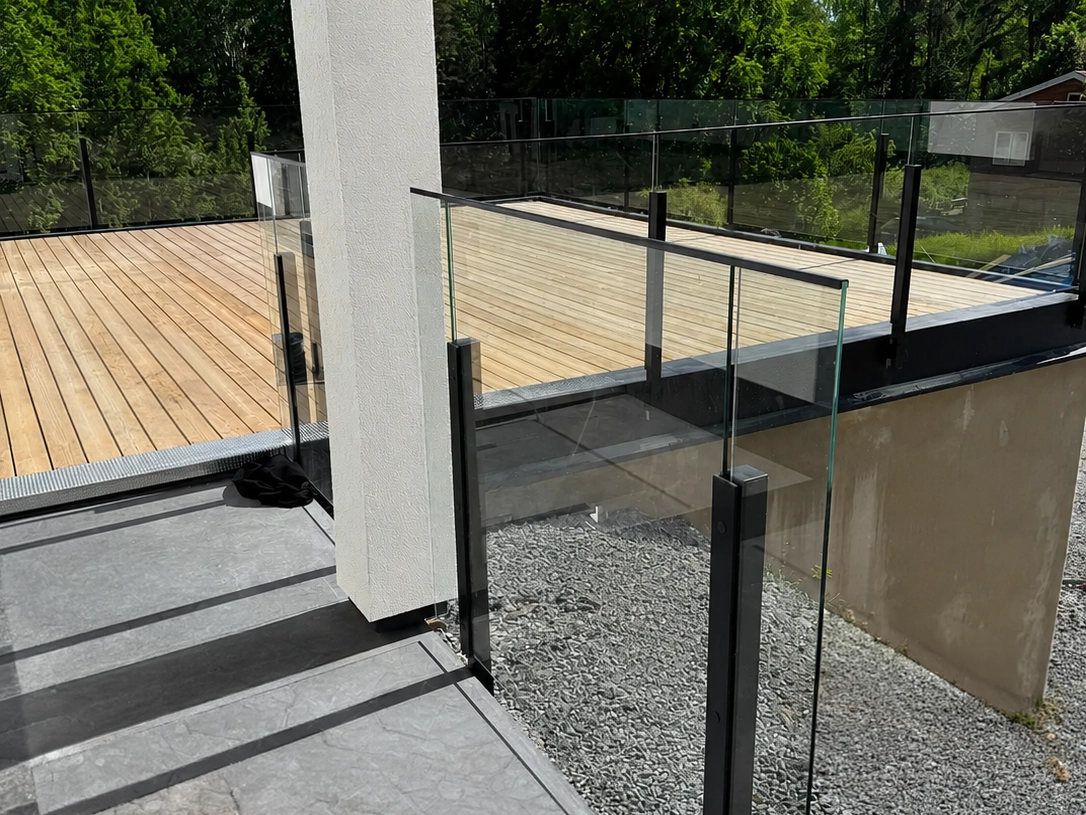
A glass railing that’s off by a few centimeters stands out immediately. The glass has no seams to hide the misalignment, and a gap against the facade or the underlying surface catches your eye every time you walk by.
It is also not possible to cut the glass to size on site. Tempered glass that is too large cannot be made smaller; it must be remanufactured.
That's why this article isn't about which glass to choose, but about how to get the measurements right from the start.

What does “custom-fit” mean?
"Custom-sized" means that the glass is cut, ground, drilled, and only then tempered—in that order, according to your measurements.
That is precisely why the measurements have to be right the first time. It is not a matter of manufacturing precision, but of what the material allows.
The aluminum profiles, on the other hand, can be cut to size, which allows for some on-site adjustments. The glass itself is finalized once the order is placed.
How to Measure
Measure each section of the railing separately and check the surface at several points. Minor irregularities in the facade, decking, or corners are rarely noticeable until the measurements are compared.
-
Measure each side separately
Measure from corner to corner. Never just give the total length around the entire railing.
-
Take measurements at three points
Check the measurement at the beginning, middle, and end of each page. The surface is rarely as straight as it appears.
-
Enter the minimum measurement
If the three measurements differ, enter the smallest one. The glass must fit at its narrowest point.
-
Check that the walls and posts are plumb
Use a spirit level on the facade and any existing posts. Note the deviation if anything is slanted.
-
Check the corner angles
Measure the angle if a corner doesn't look completely right-angled. Don't automatically assume that all corners are 90 degrees.
-
Note any changes in elevation in the ground surface
Check whether the decking, concrete, or other mounting surface rises or falls along the length of the railing.
-
Take a photo of the location from above
Take an overview photo showing the sides, corners, and ends of the railing. This photo will serve as an important reference when verifying the order.
What varies the most
Certain conditions affect the measurements more than others. Corners, sloped surfaces, and existing posts must therefore be clearly described when ordering the railing.
| Prerequisite | What It Affects | What You Need to Provide |
|---|---|---|
| Corner | Type and angle of the corner piece. | Whether it is an inner corner or an outer corner, and the angle of the corner. |
| Sloped surface | The height of the glass may need to vary along the length of the railing. | The elevation difference from one end of the route to the other. |
| Staircase | The vertical slope, not just the angle as seen from above. | Step depth, step height, and number of steps. |
| Curved facade | How the railing can be finished and fit against the wall. | The largest measured deviation in millimeters. |
| Existing poles | Whether the posts can be used with the new railing. | Center-to-center distance, dimensions of the posts, and any deviation from the plumb line. |
| Drop Height | Selection of glass, mounting, and railing dimensions. | The height from the floor or deck surface down to the ground. |
Corners are one of the most common causes of errors in orders. An inner corner and an outer corner are not interchangeable, and a corner piece cannot simply be turned the other way. Therefore, please read our explanation of the difference between inner and outer corners .
The location and height of the railing can also affect which safety requirements apply. You can read more in the Swedish National Board of Housing, Building and Planning’s guidelines on railings and handrails .
Tolerances and Clearances
Tolerance refers to the slight variation that can occur during the manufacturing of glass and other components. Clearance is a small, intentional space inside the profile that allows the glass to be installed despite these slight variations.
The game has a small assembly area
The glass should not fit exactly flush with the inner parts of the profile. Therefore, a small amount of extra space is left so that the pane can be slid into place without minor manufacturing variations preventing installation.
This does not mean that the glass is loose or that the dimensions of the railing can be changed at will. Once installation is complete, the glass is held in place by the railing system’s mounting hardware and other components.
Not centimeters
It helps during assembly
This space accommodates minor manufacturing tolerances and ensures that the glass can be positioned correctly in the railing system.
That doesn't correct an incorrect measurement
If the rail length has been measured several centimeters off or the surface deviates more than expected, there won't be enough installation space. The glass must still be ordered according to the correct measurements.
What can't be changed retroactively?
A custom-made glass railing is manufactured to your specifications. Therefore, both the glass design and the system’s specifications must be correct before manufacturing begins.
Glass Dimensions
Tempered glass cannot be cut or sanded down after it has been manufactured. Therefore, any piece of glass that is too large must be remade.
Holes and Notches
Drilling and other processing must be done before the glass is tempered. If you try to make a new hole afterward, the pane will crack.
Corner Type
Inner corners and outer corners are not interchangeable. An outer corner cannot be flipped over and used as an inner corner.
Type of Glass
Clear, frosted, or tinted glass must be specified at the time of ordering. Film applied later will not provide the same results or durability.
Profiles and Fittings
Profiles and fittings are machined specifically for the selected railing system and the current order. Therefore, do not assume that delivered parts can be cut, drilled, or modified freely on site. Always check with customer service before making any changes to a part.
Why does it take longer?
A custom-made glass railing is manufactured to your order and is not simply picked off the shelf as a ready-made, standard product. The time from order to delivery therefore involves several steps that must be completed in the correct order.
Production is based on your measurements
Dimensions, corners, glass type, and finishes are checked before production of the parts begins. This means the railing is not available in the correct lengths when the order is placed.
The glass goes through several stages
The glass must be cut, ground, and drilled before it is tempered. Where applicable, it must also be laminated before the railing can be inspected and packaged.
The season and the design have an impact
Lead times vary depending on production workload, the railing system you choose, and how the order is to be fulfilled. Therefore, please ask about the current delivery time when placing your order.
Not sure if your measurements are correct?
Please feel free to send a simple sketch with the dimensions for each side and a top-down view. Customer service can help you review the design before you place your order.
Your railing will then be manufactured to your specifications at our factory in Ängelholm.
Please have a sketch, the dimensions for each page, and a top-down view ready.
Frequently Asked Questions About Custom-Made Glass Railings
Here you'll find brief answers to the most common questions about measurements, corners, adjustment tolerance, and delivery time.
How do I take measurements for a glass railing?
Measure each side separately, from corner to corner. Be sure to check the same distance at the beginning, middle, and end, and use the smallest measurement if the results differ. Also note any corners, slopes, and changes in elevation.
Can the glass be adjusted after delivery?
No. Tempered glass cannot be cut, sanded, or drilled after it has been tempered. The small amount of adjustment allowed in the railing system aids in installation but does not alter the glass’s dimensions.
What happens if the measurements are wrong?
If the glass is too large or if holes, cutouts, or corners are positioned incorrectly, a new pane of glass may need to be manufactured. Always check with customer service before cutting, drilling, or modifying a delivered profile or hardware.
Do I have to specify the corner angles?
Yes, if the corner isn't exactly 90 degrees. Please also specify whether it's an inside corner or an outside corner. If you're unsure, a sketch and a top-down photo can help clarify the situation.
Can I reuse the existing posts?
In some cases, but it depends on the railing system, the dimensions of the posts, the center-to-center distance, and whether they are straight. Send the measurements and photos to customer service and verify the requirements before placing your order.
Why does custom-made take longer than stock items?
The railing is custom-made to order. The glass must be cut, polished, and drilled before it is tempered and, in some cases, laminated. The parts are then inspected and packaged. Lead times vary depending on the season, railing system, and design.
How much gameplay is included in the profiles?
It depends on which railing system is used. There is usually only a small amount of installation clearance, measured in millimeters—not enough to compensate for measurement errors of several centimeters. Customer service can confirm the specifications for the selected system.