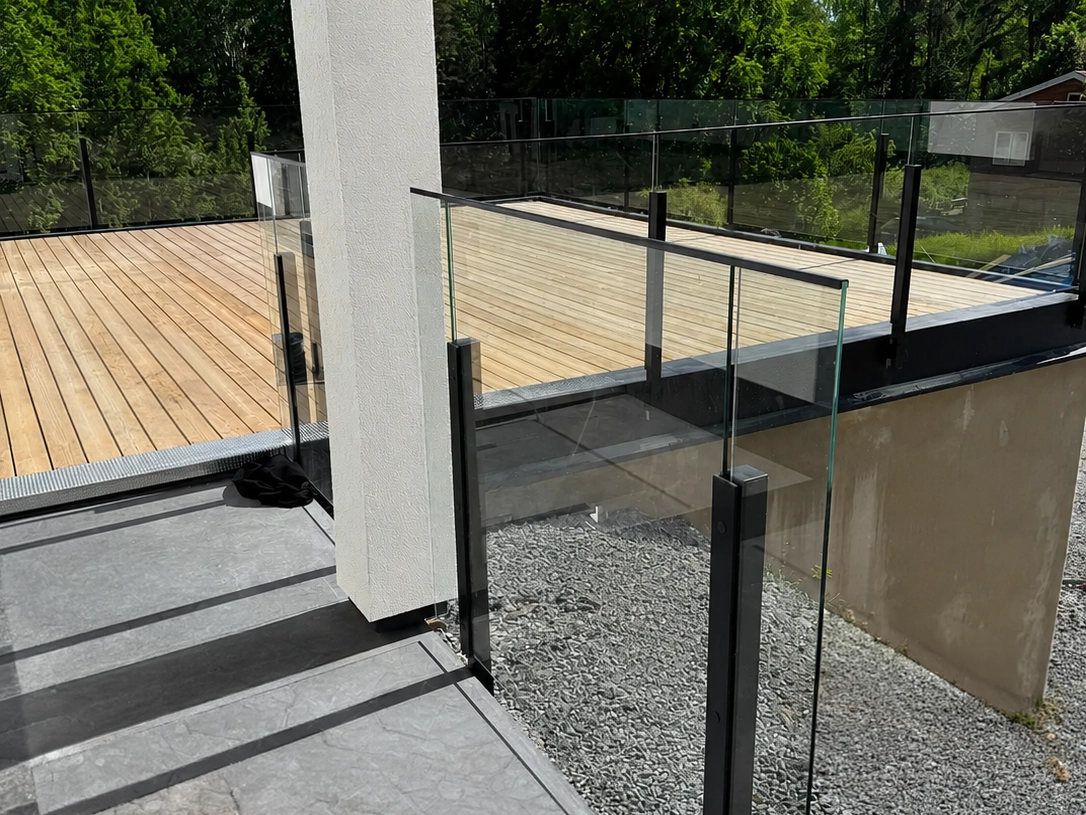
On this yellow-brick house, the balcony has been fitted with a new aluminum railing with clear glass panels. The railing runs the entire length of the front of the building, creating a secure boundary without detracting from the facade or blocking the light. The model is Forma—a balcony railing with posts made of powder-coated aluminum and laminated safety glass. The black posts create a distinct yet discreet frame, and the color was chosen to harmonize with the window frames and gutter.
Designing a Modern Balcony – Why Black Aluminum?
Glass railings are a common choice for balconies with greater drop heights, both to meet safety requirements and to preserve the openness of the building’s architecture. The combination of black aluminum and clear glass is particularly common in modern designs, especially when the goal is to have a railing that doesn’t feel heavy or bulky.
Choosing clear glass preserves both natural light and the view. On a balcony facing the garden or a street, the effect is striking—the facade features a horizontal line of glass between the windows and the gutter, and the balcony is perceived as part of the building’s overall composition rather than an addition.
Wind protection as a bonus
This type of railing also serves as a windbreak, making the balcony more usable. Because the glass blocks the wind while letting in sunlight and warmth, the space becomes a natural extension of the indoor environment.
It is precisely this dual function that makes it valuable on balconies that would otherwise be unusable for most of the year. A solid glass wall up to 1,100 mm high blocks both the wind and the view from the edges of neighbors’ balconies. This is also different from a slatted railing, through which the wind blows right through—glass truly blocks the wind, while a railing with openings does little to calm it.
Clear or frosted glass for the balcony?
| Property | Clear glass | Frosted glass |
|---|---|---|
| Transparency | Drunk – can see right through it | Diffuse – contours are blurred |
| Light Transmission | Maximum | Slightly reduced |
| Privacy screens | None | Very good |
| Windshields | Complete | Complete |
| Visual weight | Easy—the glass “disappears” | More visible – greater presence |
| Best for | Views, bright balconies | Privacy, nearby neighbors |
Clear glass is the most common choice precisely because it provides wind protection without adding visual bulk to the facade. Frosted glass is the right choice for balconies where privacy is a key concern.
Slim silhouette that maximizes surface area
Even in smaller spaces, a glass railing helps enhance the sense of space. When sightlines aren’t obstructed by slats or metal panels, the space feels larger than it actually is. This is especially valuable on small balconies—a few extra meters of visual space can make the difference between a usable balcony and an overcrowded one.
The black posts are slimmer than many people think. The standard profile is 50×50 mm, which means the railing doesn’t compete with the other details of the facade but blends seamlessly into the overall design.
The most common aesthetic mistake with balcony railings is that the color doesn’t match the rest of the facade’s details. Check how the window frames have been painted—is it RAL 9005 (solid black) or RAL 9011 (graphite black)? The Forma railing from Räckesbutiken can be powder-coated in any RAL color to match exactly. The difference between a success and a failure is often just a shade, but the effect on the facade as a whole is significant.
Safety Requirements for Balcony Railings
Balcony railings on residential buildings are governed by the Swedish National Board of Housing, Building, and Planning’s building codes. For a fall height exceeding 1.0 meter, a railing height of at least 1,100 mm is required, and the safety glass must be laminated (or tempered) to meet the fall protection requirement. Forma meets these requirements as standard.
Shaping Around a Brick Facade – Some Specific Details
Brick is one of the more forgiving facade materials for balcony railings. There is greater flexibility in choosing the railing’s color, since the brick surface is dynamic and already has its own shades. On a yellow brick building, black, anthracite, and bronze-colored railings all work well—it’s the window frames and the gutter that determine the exact shade.
Additional things to keep in mind when it comes to brick facades:
- Mounting the railing. Brick , as a load-bearing material, requires expansion screws or chemical anchors—not standard wood screws.
- Distance from the facade. The railing must extend far enough outward to allow window shutters and any balcony doors to open freely.
Find the Right Balustrade for Your Balcony
Take a closer look at our customizable Forma model, or browse our entire selection of balcony railings to find the perfect style for your facade.