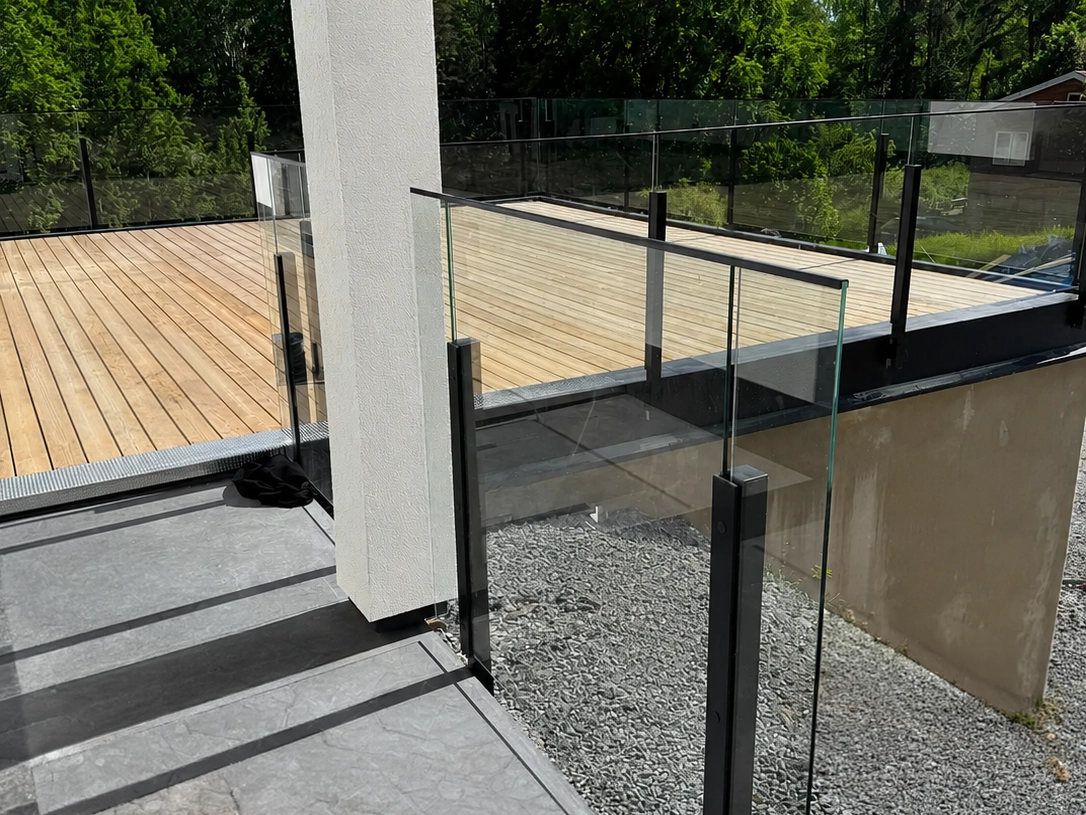
A pool overlooking a body of water—a lake, the ocean, or a pond—is one of the clearest examples of how the design of the railing directly determines whether the space feels open or enclosed. This solution features a stainless steel cable railing, creating a modern pool setting where the railing serves as a safety barrier without obstructing the view of the water.
Wire railing as an alternative to a glass railing around a pool
Glass railings are the top choice for many pools. But cable railings have their own advantages in a pool setting, especially where the view is the main attraction and a more industrial-style aesthetic is desired:
- Maximum clarity without having to clean the windows. No limescale buildup from the pool water to clean off.
- Flexible around corners. The wires are tensioned between posts at any angle, making it easy to follow the shape of the pool.
- A minimalist design. Slim posts and horizontal wires create a graphic aesthetic that suits modern gardens.
Tenso – wire railing made of acid-resistant stainless steel
The railing used in this type of pool project is our Tenso model—a cable railing in which both the posts and cables are made of acid-resistant AISI 316 stainless steel. This is a grade of steel specifically manufactured to withstand salt and chlorides—making it ideal for marine environments and pool areas. The molybdenum in the alloy ensures that the railing retains its luster year after year without corrosion.
When designing, you can choose between 4, 5, or 6 rows of wires. A denser arrangement creates a more symmetrical and substantial look, while a sparser arrangement creates a more airy look. According to regulations, wire railings should not be used as climbing ladders—we’d be happy to guide you in making the right choice.
Pool Safety—What Are the Rules?
Pools are subject to the Swedish National Board of Housing, Building, and Planning’s pool regulations —a small child should not be able to reach the water without adult assistance. For elevated pool decks, the BBR’s standard railing regulations also apply, requiring a minimum height of 1,100 mm when the drop height exceeds 1.0 meter. For in-ground pools, the minimum requirement is 90 cm, according to the pool regulations.
The wires in a wire railing are tensioned to a specific force during installation. Over time—5 to 10 years—the steel may settle slightly under constant load, and the wires may need to be retensioned. It’s especially easy to check on a pool railing: run your hand along each wire and make sure they maintain the same tension as when they were first installed. The adjustment takes just a few minutes with a hex wrench.
Maintenance – Stainless Steel by the Pool
Even acid-resistant stainless steel can develop what is known as “flash rust” over time—surface iron particles that adhere to the surface and oxidize. This is superficial and does not affect the railing’s strength. With simple maintenance a couple of times a year, you can keep the railing free of discoloration:
- Rinse with fresh water 2–3 times per season, slightly more often in coastal areas where salt accumulates more quickly.
- Use a stainless steel cleaner if surface rust is present.
- Wipe it down with a microfiber cloth to maintain its shine.
Three Questions to Consider Before Installing a Wire Rope Pool Railing
- What is the circumference of the pool area? Measure all the way around, including any steps leading into the pool.
- Is the pool deck elevated? The railing height is determined by the drop height from the outside of the deck.
- Do you need a self-closing gate? Pool regulations require a barrier that is difficult to climb over, which for private pools is often interpreted as a self-closing gate at the entrance.
The design of the wire railing by the pool
The horizontal wire structure offers a visual quality that glass railings cannot match: the railing forms distinct parallel lines that follow the shape of the pool and enhance its geometric composition. In modern pools—where the sides are straight and the corners are defined—the wires become a design element that interacts with the line of the water’s surface.
The posts can also be supplemented with a round crossbar that runs along the entire perimeter of the pool, which visually ties the railing together and serves as a handrail that’s easy to grip as people pass by. This is particularly valuable at outdoor dining areas and commercial pool facilities—the vertically filled field of wires, together with the horizontal top rail, creates an architectural line that frames the water’s surface in a thoughtful way.
Two Questions to Consider
- How should the railing be finished at the entrance to the pool area? A gate with self-closing hinges is the most common option—choose a design made of the same material as the railing for a consistent look.
- The placement of the posts. For large pools, the posts are typically spaced 1.5–2 m apart to keep the wires taut.
Find the Right Pool Fence for Your Pool
Explore our pool railings or read more about material options and regulations in our pool guide.