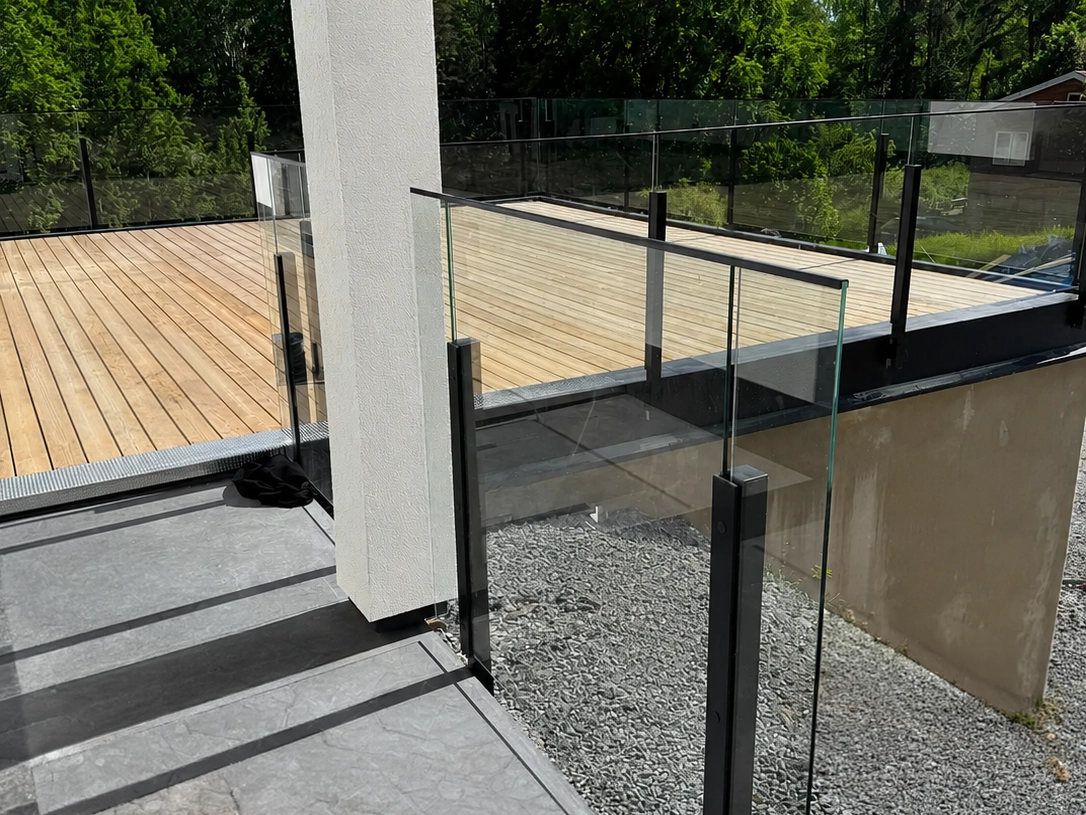
The right lighting extends the season. In the spring and fall, when the patio is actually usable if there’s no wind, darkness sets in long before the temperature drops.
That is also when the lighting on the railing is most useful, since it is the railing that marks where the edge is.
This article focuses on how LED lights, solar-powered lights, and other outdoor lighting options can be combined with various railing solutions. The lighting fixtures themselves are not included in Räckesbutiken’s product lineup, but the railing can potentially be equipped with cable grommets in the posts and profiles if this is specified prior to manufacturing.

Decide on the lighting before the railing is manufactured
This is the only issue on this page that cannot be resolved after the fact. If cables are to be run through posts or profiles, this must be planned when the railing is ordered.
Running cable through a pre-assembled aluminum post is not feasible in practice. However, if you specify when ordering that the railing should be prepared for lighting, the posts and profiles can be delivered with cable glands in the correct locations.
Solar-powered lights require no preparation at all and can be installed at any time. This makes them easy to add later on, but they also provide significantly less light.
So, the important thing is when the decision is made. If you want to run a cable through the railing, you need to specify that before manufacturing. Solar panels, on the other hand, can be added later.
LED strip
An LED strip is mounted in or under the top rail and provides an even glow along the entire length of the railing. This works especially well when the light is intended to highlight the edge without individual light points taking center stage.
Most LED strip lights are dimmable and come in a variety of color temperatures. Warm white, around 2,700 to 3,000 kelvin, usually creates the softest ambiance outdoors. Cooler light can easily feel sterile in a garden, even when the installation is otherwise done correctly.
Choose IP65 as the minimum rating for exposed outdoor locations. Near swimming pools and in areas where the lighting may be exposed to more water, a silicone-encapsulated strip with an IP67 rating is a safer choice.
Solar Cell
Solar-powered lights charge during the day and turn on at dusk via a light sensor. They require no wiring, are portable, and can therefore be added even after the railing has been installed.
The brightness is sufficient for creating ambiance and for orientation, but not for illuminating an entire area. The main factor that varies is how long the lamp can stay on after dark.
Provided that the lamp has received sufficient direct daylight.
Several cloudy days in a row are also immediately noticeable, since the battery doesn't have time to fully charge between evenings.
Placement is everything. A light that’s in the shade for most of the day won’t charge sufficiently, no matter how good the model is. So be sure to check where the sun actually hits the railing before deciding on a location.
Recessed spotlight
Spotlights recessed into posts or the crossbar provide the most polished effect but are also the most difficult to install retroactively.
Points of light along the railing
The spotlight retracts into the side of the post and can direct the light downward toward the floor, the edge, or nearby steps.
Light from above
A recessed spot in the crossbar provides a downward-directed beam without the fixture protruding from the rail profile.
The installation requires more than just a cable
The holes in the profile must be planned before the railing is manufactured. In other words, the principle is the same as with cable glands: the decision is made at the time of ordering, not during installation.
-
01
Placement Where should the light be placed?
-
02
Drilling The profile is prepared for the fixture.
-
03
Cableway The installation is being planned at the same time.
Electricity and Safety
Outdoor lighting requires both proper electrical installation and adequate protection against moisture and water. Therefore, start by separating the low-voltage circuit from the fixed 230-volt circuit.
Follow the system's instructions
In pre-assembled low-voltage systems, certain connections on the side after the transformer can be made without modifying the permanent electrical installation. Always follow the manufacturer’s instructions and do not modify the permanent installation yourself.
Hire a registered electrical contractor
Permanently connecting lighting or a transformer to a 230-volt circuit constitutes electrical work and should normally be performed by a licensed electrical contractor.
Choose the IP rating based on how exposed the location is
The more the fixture is exposed to rain, spray, or standing water, the more important the protection provided by the enclosure becomes. Always check that the product is intended for the environment in which it will be installed.
In that case, the light source can be replaced when it has reached the end of its service life. With a permanently soldered LED, the entire fixture often needs to be replaced.
LEDs use significantly less energy and have a longer lifespan. For railing lighting, there is rarely any practical advantage to choosing halogen.
Lighting in stairwells and at changes in level
This is where handrail lighting serves its most obvious practical purpose. A step that isn’t visible is easy to miss, since you won’t reach out for support unless you first notice that the ground level is changing.
Highlight the edge—not the entire staircase
Downward-facing light from the crossbar or the posts makes the front edge of the step more visible. It is precisely the transition between two levels that the eye needs to be able to perceive so that the foot lands in the right place.
On the stairs: Aim the light at the front edge of the steps.
When there is a difference in level: let the light show where the floor or ground changes.
Good lighting makes a staircase and a change in level easier to use, but does not alter the requirements for the handrail itself or other fall protection measures. These two issues must be addressed separately.
Here's how to do it—step by step
Start with the factors that can affect the railing itself. Once you've determined what preparations are possible, you can move on to selecting the lighting, the protection rating, and the installation.
-
Plan Decide whether you want lighting along the railing
If you're considering LED strips, recessed spotlights, or any other wired solution, bring it up before ordering the railing.
-
Please mention this request when placing your order
Tell us how you plan to use the lighting, and we can determine whether posts or profiles can be prepared with, for example, cable glands or holes for the specific railing solution.
-
Choose Start by considering what the light is supposed to do
Choose the solution that best suits your needs. LED strips provide even lighting, solar panels are the easiest to install retroactively, and spotlights are ideal when you want to direct the light toward a specific spot.
-
Choose warm white for outdoor use
A color temperature of around 2,700–3,000 kelvin typically provides a softer and more pleasant light on the patio.
-
Check the IP rating
Select the luminaire's protection rating based on how exposed the location is to rain, moisture, and other water-related factors.
-
Install Aim the light downward
Let the light highlight the floor, edges, and steps instead of shining directly on anyone sitting on the patio or walking by.
-
Get help with your 230-volt installation
A permanent 230-volt connection must be installed by a licensed electrical contractor. Even a low-voltage fixture may have a transformer that needs to be connected to the 230-volt side.
Would you like to prepare the railing for lighting?
Let us know when you place your order that you’re planning to install lighting, and we can see if the railing can be prepared with cable entries in the appropriate locations. The railing is custom-made at Ängelholm.
The lighting itself is not included in our product line. The ability to prepare posts and profiles depends on the specific railing solution and location.
Frequently Asked Questions About Handrail Lighting
Here are brief answers to the most common questions about preparation, IP rating, color temperature, and installation.
Do you sell lighting?
No, not at this time. However, if you are planning to install lighting, you can specify this when you place your order, and we can determine whether the railing can be prepared with cable entries for that particular solution.
What IP rating do I need?
The IP rating must be selected based on how much the fixture is exposed to moisture and water. IP44 may be suitable for more sheltered locations, while IP65 or higher may be required in more exposed environments. Special electrical regulations apply near swimming pools.
Can I dial the number myself?
Certain connections in pre-assembled 12- or 24-volt low-voltage systems may be made without modifying the permanent electrical system, provided the manufacturer’s instructions allow it. Permanent 230-volt connections must be installed by a licensed electrical contractor.
What color temperature should I choose?
Warm white, about 2,700 to 3,000 kelvin. Cooler light is easily perceived as sterile outdoors.
Do solar-powered lights work in Sweden?
In the summer, they work well for creating ambiance and helping with navigation. In the winter, their operating time is significantly shorter because the days are shorter and the battery has less time to charge.
Can I add information later?
Solar-powered lights can easily be added later. For LED strips and recessed spotlights, any wiring and drilling typically need to be planned before manufacturing. Contact us before placing your order so we can assess what preparations are possible for your specific railing.
Does lighting count as fall protection?
No. Lighting can make a staircase or a change in level easier to see and navigate, but it never replaces the need for fall protection.