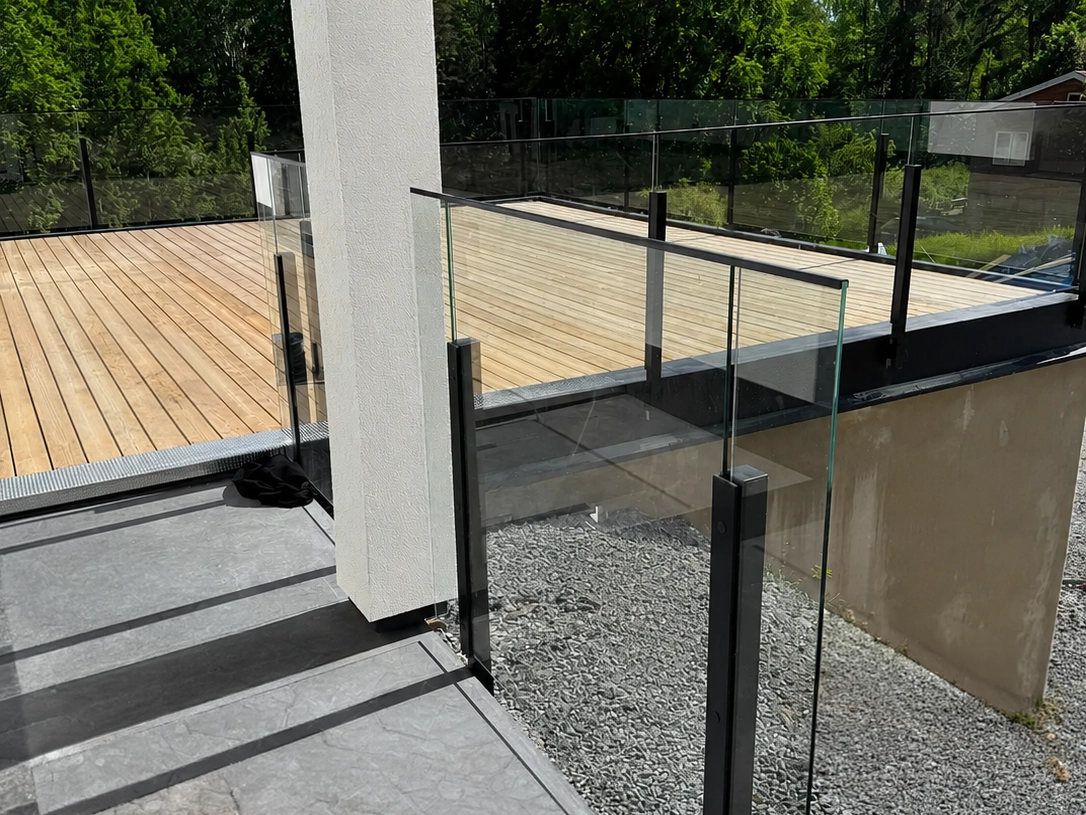
A railing is more than just a safety feature—it’s also a support system
The railing on your balcony or patio is, first and foremost, a fall protection measure—but it’s also a structure you can use to hang, attach, and decorate items. The right accessories transform the railing from a simple line around the perimeter into a support system for planters, flower pots, umbrellas, and balcony tables. In this guide, we’ll go over the four most common types of accessories, what you should keep in mind regarding safety and regulations, and how to create a cohesive look that complements both the railing and your outdoor space.
Flower box for a railing
A flower box is the most classic accessory to hang on a railing—and at the same time, the one that places the highest demands on mounting and safety. A flower box filled with moist soil and plants can weigh 25–30 kg, which requires mounts that are designed to withstand both static weight and wind loads.
We recommend using fastening systems made of powder-coated aluminum or stainless steel throughout—the same materials as the railing frame. Plastic fasteners rarely hold up over time, especially in areas exposed to UV radiation. Choose fasteners that clamp onto the railing’s top rail rather than models that hang from hooks—hook fasteners can come loose in strong winds.
Special rules apply to balconies in apartment buildings and condominium associations—many condominium associations prohibit hanging flower boxes on the exterior due to the risk of falling objects. Always check with the board before drilling or hanging anything on the outside of the railing.
Flower pots hung on the railing
Flower pots hung directly on the railing are a popular alternative to planters—especially on balconies where floor space is limited. The pot is placed on the outside or inside of the railing and secured with a clamp around the crossbar.
The advantage of using a flower pot instead of a flower box is that the weight can be adjusted more flexibly. A single pot weighs 3–8 kg, which allows you to place several smaller pots along the railing rather than a single continuous box. It also gives you the opportunity to vary the plants, heights, and colors along the length of the railing—from low-growing herbs to trailing vines.
Technically speaking, flower pots place less stress on the railing’s load-bearing capacity per mounting point, but require more mounting points if you want a dense planting arrangement. Plan on one clamp per pot, and choose clamps that match the railing’s profile (round rails require different clamps than square ones).
Balcony umbrella by the railing
A balcony umbrella is usually attached using an umbrella bracket that clamps onto the railing’s crossbar or post. It’s an elegant solution that saves floor space compared to an umbrella base that stands on the ground, and works just as well on a balcony as it does on a patio railing.
The most important thing to consider when choosing a parasol mount is that it is sized for your specific parasol model—an oversized parasol in an undersized mount becomes a safety hazard in strong winds. Always choose a mount specifically designed for balcony railings (not a generic parasol stand), and make sure you can quickly retract the parasol if the wind picks up.
For balcony railings where the load is lower, most of the umbrella mounts available on the market will work. On balconies in apartment buildings, however, it’s worth double-checking that your homeowners’ association allows umbrellas—many associations have rules about what’s allowed to protrude over the railing.
Balcony table and railing mount
A balcony table that attaches to the railing is the most space-efficient solution for a small balcony—the table hangs on the outside or inside of the railing and can be folded away when not in use. It’s a classic choice for city balconies where every square centimeter counts.
The table is typically secured with two or four clamps that grip the railing’s crossbar. The load is low during normal use (a few kilograms plus whatever weight you place on it), but you should choose a table and mounting bracket that are designed for the railing’s specific profile. Narrow balcony tables (20–30 cm deep) are fine for coffee and a newspaper; wider models up to 40 cm can accommodate a dinner plate without compromising stability.
Keep in mind that in apartment buildings, the table should not protrude too far beyond the outside edge of the railing—the same rules that apply to umbrellas often apply here as well. And just as with flower boxes and umbrella bases: choose mounts made of the same material as the railing for a cohesive look.
Safety and Rules at the Railing—What You Need to Know
Regardless of which accessory you plan to attach to the railing, there are a few general principles that govern both safety and what is permitted:
- The railing height must not be affected —no accessories may cause the railing to no longer meet the fall protection requirement (900 mm/1,100 mm according to BBR). Structures that can be climbed must be avoided.
- Emergency exits and fire safety requirements – objects must not obstruct evacuation or block emergency exits. This applies in particular to balconies in apartment buildings.
- Housing Association Bylaws and Rules – Many housing associations have rules specifying what may be hung on the balcony railing and how. Contact the board before installation.
- Warranty Implications – If the accessory requires drilling or other permanent alterations to the railing, it may affect the warranty. Clamp mounts that do not create holes in the profile are always safer from a warranty perspective.
Accessories that provide natural privacy protection
Planting along a railing isn’t just for decoration—it’s also one of the most unobtrusive ways to create privacy from neighbors or a busy street. Climbing plants such as trellis roses, climbing clematis, or ivy can, over time, form a semi-transparent layer that blocks the view without completely blocking the light.
It’s a good idea to combine plants of different heights: shorter, denser plants in the flower box at the bottom, medium-height herbs in pots, and hanging plants from the top. The result is a lush frame where the railing almost disappears behind the foliage during the summer months. For more specific privacy screen solutions made of more durable materials, see our privacy screens.
Seasons, Planting, and Maintenance
The plants in the railing planters thrive on the plants themselves, and the balcony’s changing seasons throughout the year influence both plant selection and care. Spring primroses and daffodils are well-suited for flower boxes that can withstand lingering night frosts. Summer opens the door to a wide variety of geraniums, lobelias, and petunias, often combined with herbs such as basil and rosemary. Fall can be extended with heather, fall tulips, and ornamental grasses, and winter is most beautifully captured with evergreen plants, lanterns, and lights.
Maintenance is minimal if you choose the right plants from the start: select varieties that suit your balcony’s location (sun, partial shade, windy), use soil with slow-release nutrients, and water more often than you think—planters dry out quickly because they lack the water-retention capacity of the ground.
Tips for a Cohesive Mix of Accessories
The simplest tip for making your entire balcony feel like it was designed with care: choose accessories in the same color scheme and materials as the railing. A black aluminum railing pairs well with black brackets, a black umbrella, and perhaps a table made of dark larch or black composite. A stainless steel railing takes on a more industrial look with stainless steel brackets and accessories made of natural or brushed materials.
Avoid installing a flower box, a parasol, a balcony table, and planters all at once—it quickly becomes cluttered and increases the load. Choose two or three types of accessories that complement each other, such as flower boxes and a parasol, or planters and a balcony table. For the full range of railings that these accessories are compatible with, see balcony railings and patio railings.