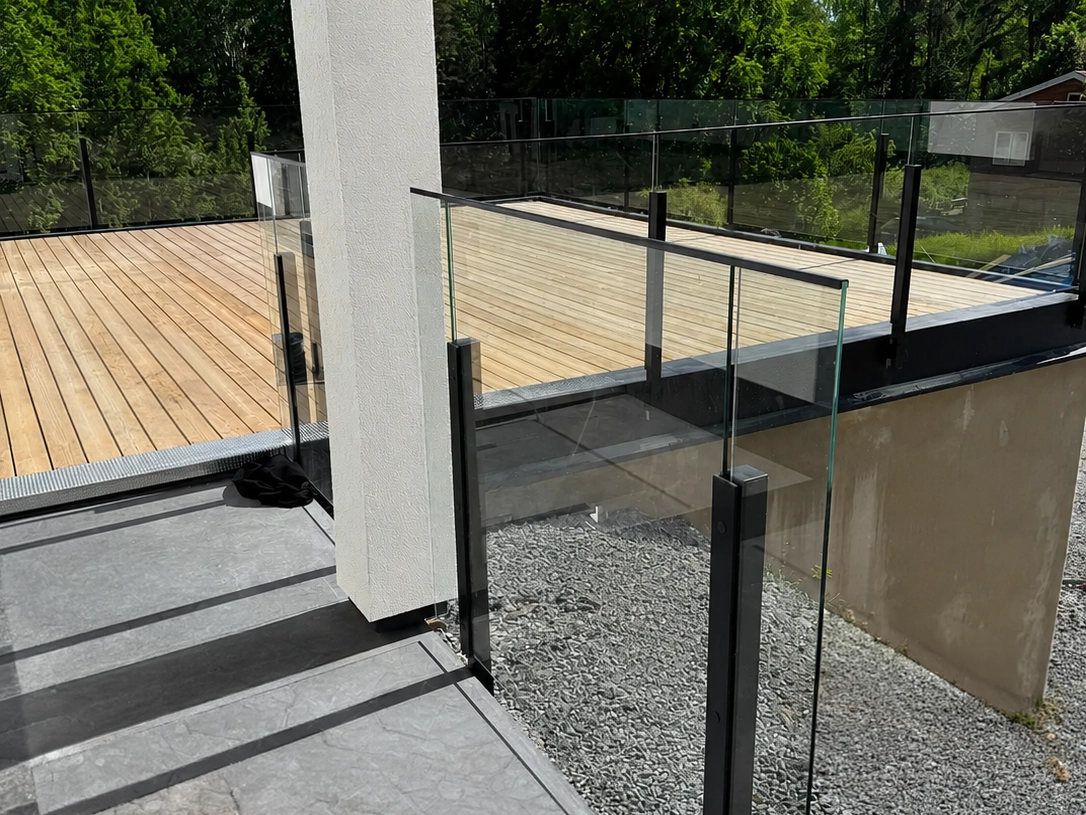
No. And that answer isn't made any better by the fact that the test with the hand feels reassuring.
A railing attached to the deck boards often feels sturdy during the first season. That’s why this problem is so common: there are no warning signs right after the railing has been installed.
The problem doesn't become apparent until the wood has shifted, the screw holes have expanded, and the fastenings start to come loose. The railing posts should therefore be anchored to the load-bearing structure beneath the deck—not to the deck boards.
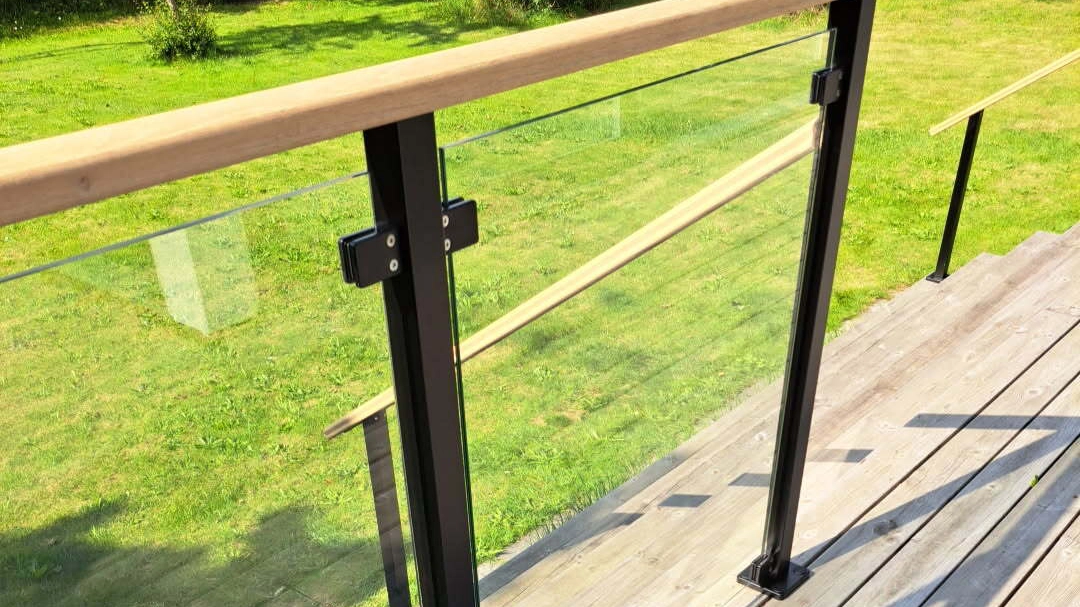
Why the deck doesn't last
The deck is a wear layer. It is designed for you to walk on, not to absorb lateral forces from a post that is over one meter high.
Two factors work against the fastening over time.
The lever multiplies the force
If someone pushes against the top of the railing, the force is magnified several times at the base of the post.
A post that is 110 centimeters high and screwed into a 28-millimeter-thick deck board creates a torque that the board is not designed to withstand.
Moisture causes the screw to loosen
Wooden decking expands and contracts with the seasons. It swells when humidity rises and shrinks when it dries out.
With every movement, the screw becomes slightly looser in its hole. That is why a railing that was tight the first summer may start to wobble after a few years.
What is the supporting structure beneath the deck?
For the railing to be stable, the mounting must reach one of the load-bearing components beneath the wooden deck.
- Carrying Line
- The thick beams that support the entire deck, usually running perpendicular to the joists. This is the strongest part to anchor a reinforcement to.
- Rule
- The joists to which the deck boards are screwed, usually spaced 40 to 60 centimeters apart. The most common support for top-mounted posts.
- Edge beam
- The outermost beam along the edge of the deck. The natural mounting point when the railing is mounted on the side outside the deck.
- Decking board
- A wear layer designed to be walked on. The deck board is not part of the load-bearing structure, no matter how thick it is.
When the line isn't where the pole is supposed to be
This is the real problem when installing a railing on an existing wooden deck. The solution is to adjust the spacing of the posts or reinforce the supporting structure.
| Solution | When it's convenient | Things to Keep in Mind |
|---|---|---|
| Move the pole | The deviation is a few centimeters. | Adjust the spacing of all the posts so that the distances remain even. Do not move just a single post. |
| Install an additional stud | You can access the structure from below. | The new stud must be anchored to the existing load-bearing structure, not just wedged between other studs. |
| Use a reinforcement plate | The load needs to be distributed over a larger area. | The sheet metal is designed to transfer the load to several studs. It does not make the deck board itself load-bearing. |
| Mount on the side of the edge beam | The edge beam is intact and accessible. | The post is anchored directly to the edge of the deck and takes up less space on the deck itself. |
Side mounting can solve the problem completely
Side mounting is often the easiest option when the studs don't align with the post spacing. The edge beam follows the outer edge of the deck and provides a natural mounting surface.
This method also saves floor space because the post base does not need to be placed on top of the wooden decking.
Read about top and side mounting at the edge of the balconyThe height of the fall does not change the substance of the matter
A low deck and a high deck share the same basic mounting principle: the railing posts should transfer the load to the joists, support stringers, or edge beams—not remain in the wooden decking.
The post must always reach the load-bearing structure
The height of the deck does not make the decking boards stronger or weaker. What determines whether the fastening works is what the post base is anchored to and how the load is transferred through the structure.
A loose railing is still a defect
On a deck twenty centimeters above the grass, poor fastening may primarily result in looseness, crooked posts, and a railing that needs to be redone.
The consequences could be significantly greater
When the difference in level is greater, the same design flaw can have more serious consequences. That is why it is especially important to ensure that the mounting is correct from the start.
Here's how to do it—step by step
Check the structure beneath the wooden deck before deciding on the placement of the posts and the type of installation.
-
Find the joists under the wooden deck
Follow the rows of screws in the deck boards. The screw heads indicate where the joists run beneath the deck.
-
Measure the standard distance
Measure the distance between the studs and mark where the railing posts should go based on the planned layout.
-
Check corners and endpoints
Make sure the post spacing is consistent along the entire length of the railing. Corners, end caps, and connections should be planned before moving any individual post.
-
Select installation type
Choose between top mounting with fastening to the framing or side mounting to the deck’s edge beam.
-
Strengthen where rules are lacking
Install an additional stud or other suitable reinforcement from below. The reinforcement must be anchored to the load-bearing structure; it should not simply be wedged in place.
-
Check the hole pattern on the post base
Before drilling, compare the distance between the mounting holes to the width of the batten. All fasteners must have sufficient support.
-
Check and retighten
Check the fastenings after the first season and retighten them if necessary. Wood expands and contracts with changes in humidity and temperature, even when the railing is installed correctly.
Do not drill until you have checked the entire post spacing, the installation type, and the reinforcement beneath the wooden deck.
Not sure what's under your wooden deck?
Check out our custom-sized railings, or send us a photo of the deck from below and let us know the spacing between the joists, and our customer service team will go over the mounting requirements with you.
Our railings are custom-made and manufactured in Ängelholm.
Frequently Asked Questions About Wooden Deck Railings
Here you'll find brief answers about mounting, joists, and what you need to check before installing a railing on a wooden deck.
Can you attach the railing directly to the wooden deck?
No. The decking boards serve as a wear layer. They must be fastened to a joist, support rail, or edge beam that can transfer the load through the structure.
How do I find the rule under the wooden slats?
Follow the rows of screws in the deck boards. The screws are located where the joists run, since the wooden deck is screwed into them.
What should I do if there isn't a rule about where the pole should be placed?
You can move the post, install an additional stud or other reinforcement from below, or opt for side mounting by attaching it to the edge beam.
Is it enough to use a longer screw?
No. The problem isn't just the length of the screw, but the material it's being screwed into. A long screw won't help if it doesn't reach a load-bearing part of the deck.
Why does the railing still feel sturdy?
When you test the railing with your hand, you’re applying a limited amount of force to it. The railing should also be able to withstand a significantly greater load—for example, if a person falls against it.
Can a railing attached to the wooden deck still hold up?
It may feel stable for a while, but wood moves as the moisture content changes. Over time, the screw holes can become enlarged, and the fastenings may start to loosen.
Does the height of the balcony matter when it comes to mounting it?
Not because of the basic principle. The railing must be anchored to the load-bearing structure regardless of the deck’s height. However, the consequences are more severe if the fastening fails where there is a significant difference in level.