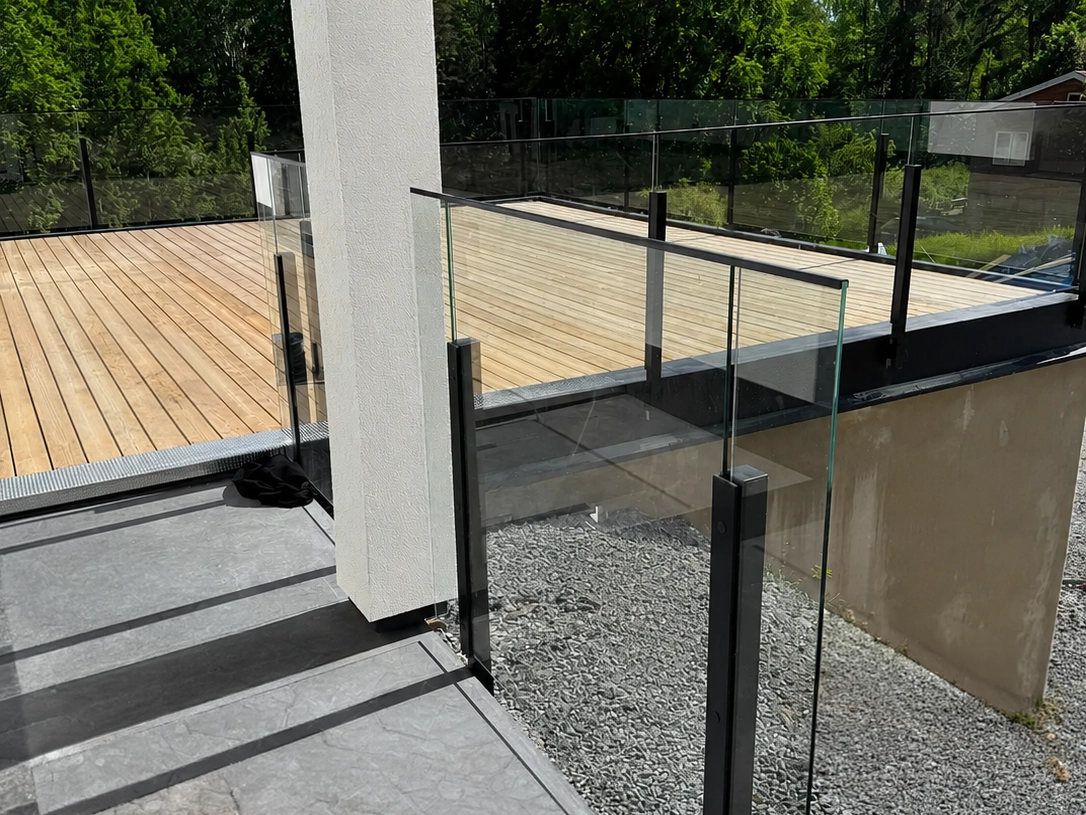
A privacy screen consisting of a fence and a hedge provides privacy without blocking out light and air. The choice often comes down to an either/or decision between a built barrier and greenery.
But the two address different aspects of the problem. The fence has an immediate effect. The hedge adds depth, but it takes years to grow.
In this article, we'll go over the differences between fences and hedges, how to combine them, and what happens during the winter months.
Which privacy screen is right for which situation?
Start with the location and what's most distracting.
| Location | Common problem | A Solution That Often Works |
|---|---|---|
| Facing the street or the sidewalk | Visibility and Sound | A fence, preferably with a hedge in front of it |
| Toward the neighbor's balcony | View of the seat height | A fence or a more solid barrier |
| Narrow lot | The hedge takes up too much space | Fence with climbing plants |
| Large garden | Needs softness | Hedge, with a fence along exposed sections |
| The winter months | Deciduous hedge stands bare | Fence as a baseline |
| Newly Developed Lot | Nothing is growing yet | A fence now, a hedge that will grow in |
The table is simplified. However, it shows that a physical boundary is rarely needed around the entire lot.
Start by considering where transparency comes from
Before you choose a solution, go outside and sit where you actually spend time—at the dining area, in the lounge chair, or on the steps.
Then look to see where you feel like you're being watched from.
It often turns out that the view comes from one or two directions, not from all sides. It could be a neighbor’s balcony, a window at an angle, or a walkway.
The rest of the property line can then be left more open. This saves money and makes the garden feel more spacious.
Bring a chair outside and sit in the spots you use most often. Note which sightlines are obstructed.
Often, simply blocking out a single direction is enough to completely change the atmosphere.
Fence or hedge—what's the difference?
Fences and hedges serve different purposes. A fence provides a clear boundary right away, while a hedge creates depth, greenery, and softer transitions over time.
- Fence
- It takes full effect immediately. The height is exactly what you chose, and the boundary is clear from day one. It takes up a little space widthwise, which matters on a smaller lot.
- Hedge
- It adds depth, dampens noise, and provides a habitat for birds and insects. A newly planted hedge takes several years to become dense.
- Combination
- The fence provides a basic level of privacy year-round, while the hedge adds greenery during the growing season. This is the solution many people choose when their lot allows for it.
- Climbing Plants
- Adds greenery without taking up floor space. A slatted fence provides support for plants without the need for a separate trellis, making it a good fit for narrower lots.
| Property | Fence | Hedge | Combination |
|---|---|---|---|
| Impact in the First Year | Full | Limited | Full |
| The winter months | Unchanged | Open About Deciduous Trees | Unchanged base level |
| Horizontal space | Small | Large | Largest |
| Care | Low to moderate | Trimming every season | Both parts |
| Noise Reduction | Limited | Good | Good |
Should the hedge be in front of or behind the fence?
The placement determines both what you see from the garden and what your neighbor or passersby on the street see from the outside. Here, we’re referring to the front and back as seen from your own property.
The most important thing is to decide whether you want to see the greenery right next to you, or whether the fence should serve as a clear boundary in the garden.
Hedge in front of the fence
Place the hedge on your side of the fence. That way, you'll see the greenery from your garden, while your neighbor or passersby on the street will mainly see the fence.
This is often the most natural solution when the fence is close to the property line. A dark fence then serves as a tranquil backdrop behind the vegetation.
Hedge behind the fence
Place the hedge behind the fence as seen from your garden. That way, the fence will serve as the clear boundary you see, while the greenery softens the view behind it.
This works well when the fence itself is part of the garden's design—for example, if the color, slats, or lines are meant to be clearly visible.
Always leave some space between the hedge and the fence
If they are planted too close together, both pruning and maintenance become difficult, and air circulation is impaired.
Plan so that you can access the back of the hedge and both sides of the fence from your own property.
Climbing Plants When Space Is Limited
On a small lot, there is rarely room for a hedge that spreads out one meter in each direction.
Climbing plants growing directly on or next to the fence are one way to bring some greenery into the space after all.
A picket fence works well as a support, since the gaps allow the plant to cling to it without the need for a separate trellis.
Once the plant has taken root, the fence becomes harder to reach. If the fence needs to be painted or treated regularly, it becomes a recurring task.
Privacy Protection During the Winter Months
The most common disappointment with an all-hedge solution occurs during the winter months.
Many deciduous hedges become significantly sparser once the season is over. A yard that felt completely secluded in July may therefore become more open in November, just when the lights are turned on indoors and the view into the yard is most noticeable.
This is where the combination is most beneficial. The fence remains unchanged while the hedge is at rest.
If you want greenery even in the winter, there are evergreen options, but they often grow more slowly and have higher demands in terms of soil, location, and establishment.
The fence maintains the base level year-round
A hedge can add softness, greenery, and depth throughout the season. But if you want it to provide privacy even when the foliage is sparser, the built boundary often has to do the groundwork.
Important Things to Consider Before You Start Planning
A good boundary isn't just about height and materials. It should also be practical for everyday use, easy to maintain from the right side, and blend naturally into the garden.
- Vary the heights
- A boundary that maintains exactly the same height all the way around the lot can easily come across as institutional. Lower sections where visibility isn’t an issue create a more garden-like overall impression.
- Plan for your own maintenance
- Both fences and hedges should be maintainable without having to step onto your neighbor's property.
- Check the rules
- Height, placement, and distance from the property line may be subject to local regulations. Hedges are often subject to different regulations than built structures.
- Talk to your neighbor first
- It prevents conflicts and can lead to a mutually beneficial solution.
How to Plan Your Boundary – Step by Step
Start by identifying your needs before choosing a solution. This will make it easier to determine where a fence is needed, where a hedge will be most useful, and which parts of the property can be left open.
- Sit on the patio and note where the view is coming from.
- Mark where the constructed boundary is needed—often just one or two sides.
- Choose the height based on your needs; don't use the same height all the way around.
- Decide where to place the hedge—in front of or behind the fence.
- Check with your local municipality to see what the rules are for both fences and hedges.
- Check with your neighbor before you get started.
Not sure how to define the boundaries of your garden?
Start by determining where the light is actually coming from. If you need help with height, materials, or placement, customer service can assist you further.
Frequently Asked Questions About Fences and Hedges
Should the hedge be planted in front of or behind the fence?
The most common practice is to plant the hedge in front of the fence as seen from your own property. That way, you can see the greenery from your garden, while your neighbor or passersby on the street mainly see the fence. Always leave enough space in between for trimming and maintenance.
How close to the fence can you plant a hedge?
It depends on the type of hedge and how wide it will be when fully grown. Plan so that you can access both the back of the hedge and both sides of the fence from your own property.
What rules apply to fences and hedges along property lines?
The rules may be affected by height, density, location, and local regulations. The Swedish National Board of Housing, Building, and Planning describes the difference between a wall, a picket fence, a deck, and a fence. Always check with your municipality if you are unsure.
Do climbing plants grow well on a picket fence?
Yes, the gaps provide natural support for the plant. Just keep in mind that the fence will be harder to access once the plant has taken root, especially if the fence needs to be painted or treated.
What provides the best privacy protection in the winter?
A man-made structure provides the most predictable privacy in the winter, since it remains unchanged year-round. Evergreen hedges can also work, but they take time to establish and are more demanding in terms of soil and location.
Do I need to fence off the entire lot?
Rarely. The view usually comes from one or two directions. If you only screen off the areas where it’s needed, the garden often becomes both more open and more natural.