For a house with a strong, distinctive character, the railing becomes a design decision that’s less about the product itself and more about the building it will be installed on. In this client project, we show how a wrought-iron balcony railing in a custom green shade became the detail that tied an entire facade together—and why the choice of color proved to be more important than the choice of model.
The starting point: a balcony railing that must reflect the style of the house
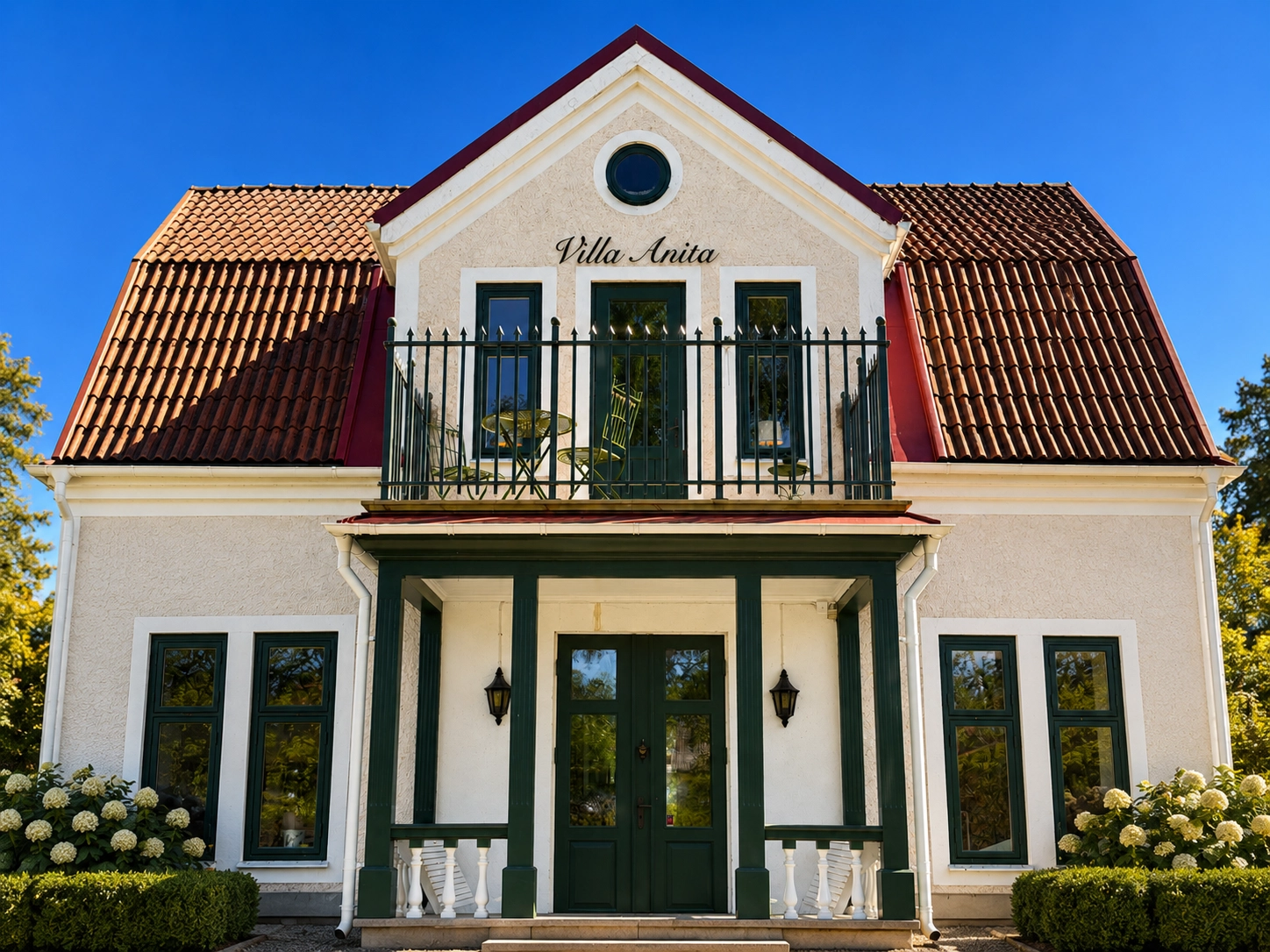
Villa Anita is a stucco villa with a red-tiled roof, mullioned windows, and deep green woodwork that runs throughout the building—window frames, the front door, shutters, and the porch all share the same shade of green. The balcony is centrally located on the gable end of the upper floor, symmetrically above the entrance, and is the first thing the eye catches from the driveway.
This makes the balcony railing one of the most visible design choices in the entire building. The challenge was twofold: the railing needed to serve as a safe fall protection barrier, but it also had to fit into a facade that already has a strong visual identity. A railing with the wrong design language—too modern, too heavy, or in a color that disrupts the green theme—would have altered the entire look of the building.
The Solution: Retro wrought-iron railing in a custom green finish
We chose Retro, our powder-coated aluminum wrought-iron railing with a classic design. The model features vertical balusters topped with spearheads, ornamental details in the lower section, and a top rail that finishes the railing with a clean horizontal line—the type of wrought-iron work historically found on turn-of-the-century-style homes.
But the key detail in this project wasn’t the model. It was the color. Retro comes standard in black, white, and gray, but we also offer any RAL color of your choice. In this case, the railing was ordered in a deep green shade, precisely matched to the home’s existing woodwork. The result is a wrought-iron railing that doesn’t look like an afterthought—it appears to be an original part of the architecture, on the same visual plane as the windows and doors.
A black wrought-iron railing would have served as a fall protection barrier, but it would have introduced a new color into a palette that is already set. On a facade where everything else harmonizes, a contrasting color becomes more noticeable than one might expect—and a matching color has a greater impact.
Outdoor aluminum wrought-iron railing — the look without the maintenance
Traditional wrought iron has exactly the design aesthetic this villa calls for, but it comes with practical trade-offs. Rust, repainting, and regular maintenance are a reality for outdoor wrought iron in a Nordic climate—especially on an exposed balcony. Retro achieves the same visual effect in powder-coated aluminum, which means the railing won’t rust, the color will retain its intensity without repainting, and maintenance is limited to a simple rinse.
It’s a difference that’s especially noticeable over time. The green hue remains identical to the house’s trim season after season, without the homeowner having to maintain the balcony railing to keep it matching the rest of the facade.
The balcony has been furnished with a bistro table and wrought-iron chairs in the same shade of green. Despite the limited space, the result is a cohesive outdoor living space—precisely because the color and design language are consistent across the railing, the furniture, and the house.
Balcony railing height, balusters, and the Swedish National Board of Housing, Building and Planning's building codes
Balcony railings are subject to the Swedish National Board of Housing, Building, and Planning’s building codes, which require a minimum height of 900 mm. The spacing between the balusters must be limited so that children cannot crawl through, and the structure must not have horizontal elements that provide a foothold for climbing. Retro’s vertical balusters naturally meet these requirements—the safety feature is built into the design without compromising its aesthetic appeal.
The height of balcony railings is particularly relevant when renovating older single-family homes, where existing railings may fall short of current standards. Installing new balcony railings then provides an opportunity to improve safety and refresh the facade at the same time. In this case, the height was adjusted to comply with regulations and the existing proportions of the balcony opening.
Inspiration for those planning a wrought-iron railing for their balcony
If you're planning a balcony railing for a house with classic architecture, there are three questions that will guide your choice:
- What architectural style suits the house?Wrought iron with ornaments and spearheads evokes the turn of the century and classic Swedish architecture. Glass and aluminum are more commonly found on modern buildings. Let the house decide.
- What color scheme does the facade have?Standard black works well on many houses, but on a single-family home with a consistent color scheme in the woodwork, a custom color can make the difference between a railing that’s simply attached to the house and one that’s an integral part of it. See the entire Retro collection with all its color options.
- How do the railing’s proportions affect the facade?The level of detail in the ornamentation and the height of the railing must be in proportion to the size of the balcony opening and the scale of the facade.
A wrought-iron railing that is part of the house
This project shows that choosing a balcony railing for a distinctive single-family home isn’t about finding the most impressive product—but rather about finding the one that fits best. A retro style in a custom shade of green isn’t a complicated solution, but it’s well-balanced: the design, color, and proportions are inspired by the building rather than competing with it.
That's how we approach all projects where the building already has a distinct identity: the railing shouldn't be the focal point—it should enhance the rest of the facade.