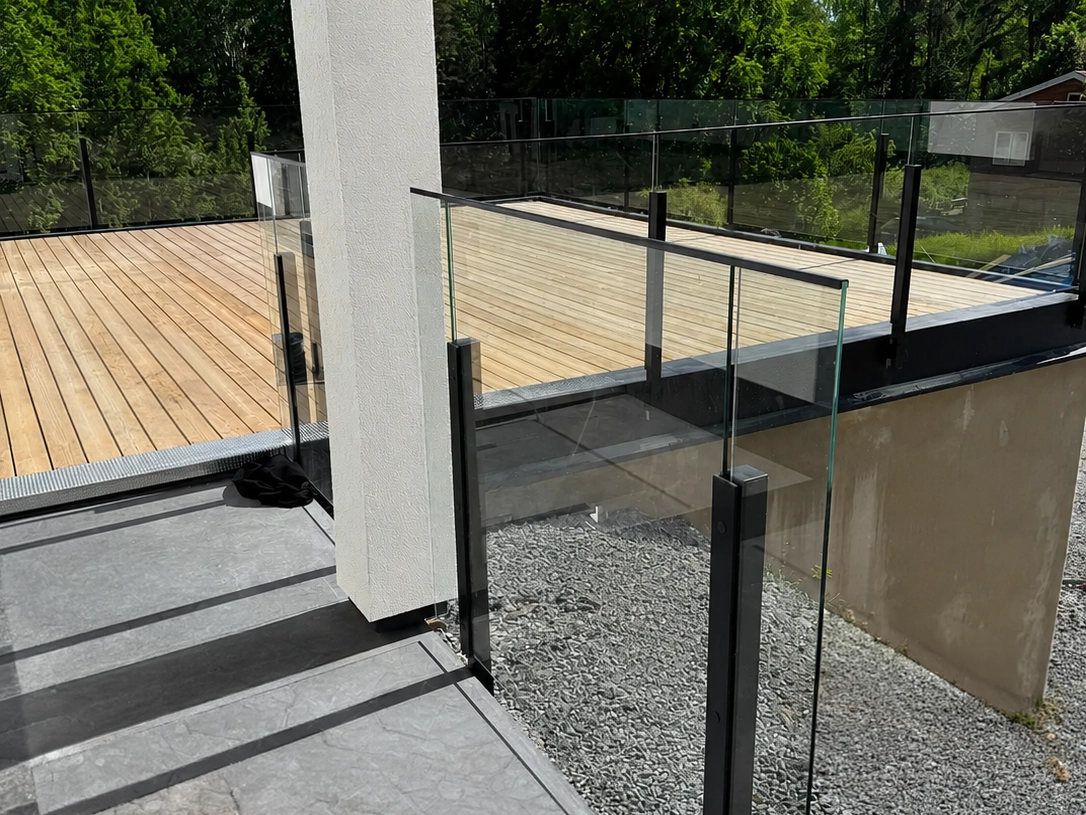
On this elevated patio, a stainless steel cable railing runs along both the staircase and the edge of the patio. The railing consists of slender round posts and horizontal cables that create an open feel and provide an unobstructed view of the garden. What ties the whole design together is that the same railing continues—using the same material and design language—from the top of the patio down to the bottom step of the staircase.
When the balcony and stair railing form a single, integrated system
The transition between the balcony railing and the stair railing is one of the details that directly determines how professional a railing installation appears. On this balcony, the railing system is uniform:
- The same material is used throughout the entire length. AISI 316 stainless steel is used in both the deck and stair sections.
- The same post profile. Slender , round posts of the same diameter, whether they’re on the deck or follow the slope of the stairs.
- Wires at several different heights. The horizontal wires run parallel to each other and flow naturally from the horizontal line of the balcony down along the stairs.
- Continuous round handrail. Provides a natural grip along the entire length of the railing—serving both as a guide on the stairs and as a visual line on the deck.
AISI 316 – acid-resistant stainless steel for outdoor use
The posts are made of AISI 316—acid-resistant stainless steel designed for outdoor use. This grade of steel can withstand moisture, cold, and temperature fluctuations in the Swedish climate without corroding. For balconies inland, standard-grade stainless steel is usually sufficient, but for coastal locations or where the balcony is exposed to salt, AISI 316 is our standard choice.
Stainless steel requires minimal maintenance, but it is not maintenance-free. As you can read in our product description for Tenso: despite its name, stainless steel can develop what is known as “flash rust”—surface iron particles that adhere to the surface and oxidize. This is superficial and can be resolved with simple maintenance a couple of times a year.
Mounting of the Stair Section
The stair section has an angled mounting that follows the angle of the steps. It is not a simple task to ensure that the stair section aligns properly with the balcony section—the position of the posts, the alignment of the cables, and the angle of the guide rail must all work together.
At Tenso, the staircase angle and the placement of the posts are customized at the time of order based on the staircase’s dimensions. That’s why we always ask for both the staircase’s dimensions and the balcony’s dimensions at the same time when you place your order—that way, we can prepare all the parts so they fit together correctly.
Wire railing mounted on top of the deck
In this project, the railing is mounted on top of the decking, which complements the clean lines of the deck. This mounting method has its advantages: the posts are anchored to the load-bearing substructure directly beneath the decking, providing maximum stability. The top surface of the decking remains unobstructed, and the base of the posts becomes part of the deck’s silhouette.
Safety and Rules
The railing on the balcony is subject to the Swedish National Board of Housing, Building and Planning’s building codes when the fall height exceeds 1.0 meter—a minimum height of 1,100 mm. For the staircase section, the measurement point is different: approximately 900 mm from the front edge of the step. Both heights are adjusted at the time of order based on the specific dimensions of the balcony and staircase.
When designing your wire railing, you can choose between 4, 5, or 6 rows of wires. The choice is based on both aesthetics and how dense the railing should appear. The Swedish National Board of Housing, Building, and Planning’s building codes note that horizontal wires can be climbed—which is why we often recommend a denser arrangement (5–6 rows) on a patio where small children play, both for safety and for a more substantial appearance.
Three Questions to Consider Before Installing a Combined Balcony and Stair Railing
- Measure the balcony and staircase at the same time. Send a sketch or photo so that the transitions and corners are documented.
- What is the slope of the staircase? Measure both the rise (height per step) and the run (depth per step)—these determine the geometry of the handrail.
- Do you need gates in the railing? If you have a pool or any other area where a child safety gate is needed, this should be planned from the start.
Two details that matter more than you might think
In this type of installation, there are two details that are easily overlooked but have a significant impact on the final result:
- The exact vertical alignment of the posts. Posts that are even just a few degrees off are clearly noticeable along a long balcony railing because our eyes pick up on deviations from the plumb line. Installation requires a level and patience.
- Wire tension. Wires that are too loose look sloppy and do not meet safety requirements. Wires that are too tight place unnecessary strain on the poles. The correct tension is firmness without visible sagging, and is checked during installation.
Find the Right Railing for Your Patio
Explore our wire railings for an open, maritime look, or browse all our patio railings to find the perfect solution for your specific project.