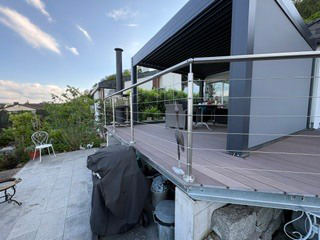
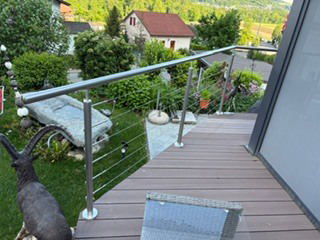
When the whole point of a patio is the view, every horizontal and vertical line in the railing becomes a design consideration just as important as the color of the facade. In this client project, we show how a wire railing made of acid-resistant stainless steel solved a classic dilemma: creating an approved fall protection system without obstructing the very view that inspired the client to build the patio in the first place.
The starting point: a patio where the line of sight is the most important detail
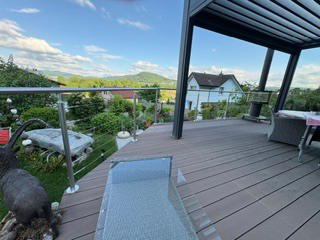
This patio was built with a single, clear purpose in mind—to frame the sweeping view of the surrounding landscape. Situated on a wooden deck atop a stone wall, the area is exposed to both sun and wind, and the difference in elevation makes a railing necessary under current building codes.
The challenge is therefore twofold: the railing must serve as a stable fall protection, but under no circumstances should it compete with the view it is meant to frame. A denser railing made of wood or wrought iron would have created a strong horizontal focal point at eye level and interrupted the line of sight toward the landscape. A glass railing would have provided an unobstructed view, but it would also have introduced reflections in the evening light and a more urban aesthetic that did not belong in this natural setting.
The Solution: Tenso wire railing made of acid-resistant stainless steel
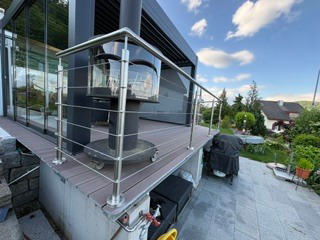
We chose Tenso, our stainless steel cable railing system in which horizontal cables are tensioned between slender posts made of acid-resistant steel. It’s a system that creates an airy yet sturdy impression—the cables are thin enough to almost disappear against a background, while the frame is designed to withstand high wind loads in exposed locations.
The posts are made of acid-resistant stainless steel (AISI 316), an alloy that contains molybdenum and therefore resists corrosion better than standard stainless steel—a crucial factor in environments where salt, rain, or temperature fluctuations put the material under stress year-round. The cables are tensioned using a tensioning mechanism that ensures they maintain their stiffness over time, without sagging or vibrating in strong winds.
The result is a railing that does exactly what a good fall protection system should do: it’s there when you lean on it, but it doesn’t distract you from what you’re looking at.
Why Cable Railings Work When the View Is a Priority
There is a specific reason why railings with horizontal wires have become a popular choice for modern patios, terraces, and docks—and it has to do with how the eye perceives the environment.
When you stand on a patio with an unobstructed view, your gaze is instinctively drawn outward, toward the horizon. A wooden railing or one with denser balusters creates a visual barrier that interrupts that line of sight—your eyes are drawn to the railing before they reach the landscape. Cable railings solve this problem because their horizontal lines are so thin that they blend into the background, whether that background is the sky, water, or a forest.
The nautical feel that railings provide—reminiscent of the details on a sailboat—works especially well when the surroundings themselves are close to nature. The railing becomes part of the same aesthetic language as its surroundings, rather than being an element borrowed from an urban environment.
Safety, Cable Clearance, and the Swedish National Board of Housing, Building, and Planning's Building Regulations
Wire railings present a specific safety issue: the spacing between the wires. According to the Swedish National Board of Housing, Building and Planning’s building codes, no openings in a railing structure may be larger than 100 mm—the so-called “100 mm rule”—to prevent children from getting stuck or using the railing to climb. When we design a wire railing, we therefore calculate the number of wires and their placement based on the selected railing height.
For this project, with a railing height adapted to the deck’s fall height, this meant that a specific number of cables were distributed evenly over the height to comply with regulations. The dimensions of the posts and the fasteners’ attachment to the deck were calculated according to Eurocode to withstand horizontal point loads and wind loads. For more detailed information on fall protection regulations, see our railing guide.
Custom sizing, acid-resistant steel, and installation on a wooden deck
Each Tenso railing is custom-made to fit the specific surface—no on-site cutting is required. In this project, the post spacing was adjusted so that the posts were positioned symmetrically along the edge of the wooden deck, making the railing appear as an integral part of the structure rather than an afterthought.
Mounting on a wooden deck requires special design considerations. We use heavy-duty through bolts or screw connections that are fastened directly into the load-bearing framing beneath the deck, not just into the top deck boards. This ensures that the posts remain stable even when the railing is subjected to horizontal loads from a person leaning against the cables or from crosswinds.
Since the entire system is made of AISI 316, maintenance is minimal—rinsing with fresh water 1–2 times per season removes particles and dirt, and, if necessary, gentle polishing can restore the luster to heavily used parts. For more detailed information on acid-resistant steel, see “Stainless Steel Handrails.”
Inspiration for Outdoor Spaces with a View
If you're planning an outdoor space where the view is the most important design factor, there are a few questions worth considering early on:
- Where is the gaze directed? The railing should be positioned so that it does not block the main direction that the eye naturally follows.
- What is the view behind the railing? Against the sky or the water, the cables disappear almost completely. Against a denser landscape, a glass railing can provide a cleaner view.
- What kind of stress will the material be subjected to? In coastal or exposed locations, acid-resistant (AISI 316) steel is not an option but a requirement. See our full selection of wire railings for more options.
A railing that lets the view take the lead
This customer project is a great example of how a well-designed railing knows its place. Tenso isn’t the most visually elaborate product in our lineup—and that’s exactly the point on a patio where the outdoor scenery should take center stage.
This is how we think about outdoor spaces with expansive views: the railing is not a design element meant to compete with the view, but rather a technical solution designed to allow people to safely enjoy the view.