You rarely buy a railing more than once. It’s meant to stay in place, withstand the elements, and still look like something you’ll like in fifteen years.
The material determines all of that. It determines how many hours you’ll need to spend each year, how the railing will age, and how well it will complement the house.
This article provides an overview of the most common materials. If you'd like to explore a specific comparison in more depth, we'll provide links where appropriate.

Which material is right for your environment?
The materials differ primarily in how much maintenance they require, how they age, and the look they give the house and the patio.
| Materials | Maintenance | Service life | Expressions | Best for |
|---|---|---|---|---|
| Wood | Oil or paint every other year | Ages 10–15 | Warm, classic | Older Houses and Green Spaces |
| Aluminum | Wipe dry | 25 years and older | Minimalist, neutral | Most environments |
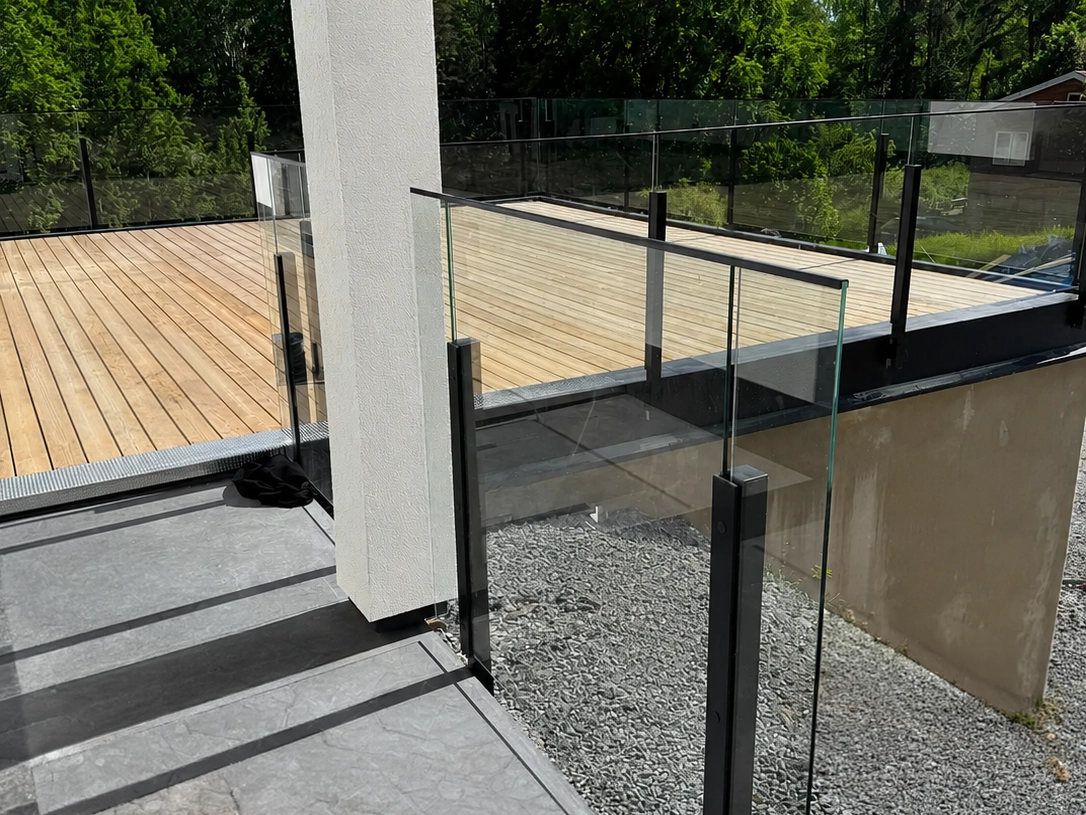
| Glass | Cleaning | 25 years and older | Open, modern | Where the view is the main attraction |
| Stainless steel | Easy cleaning | Very long | Timeless, elegant | Beach, Pool, and an Exclusive Atmosphere |
| Aluminum Forging | Wipe dry | 25 years and older | Decorative, handcrafted | Turn of the Century and Functionalism |
| Wire | Voltage Check | Long | Almost invisible | A view without the need to clean the glass |
Aluminum is the middle ground that works almost anywhere. Wood and glass are the extremes: one requires the most work and provides the most heat, while the other requires the least maintenance and lets in the most light.
The Two Most Common Questions
Two comparisons come up more often than any others. Which one is relevant to you depends on whether your decision is primarily based on maintenance, the view, or the atmosphere of the house.
Wood or aluminum
It almost always comes down to how much work you're willing to put in and what the railing will cost over time.
Pressure-treated wood has a lower purchase price, but needs to be oiled or painted regularly. Aluminum costs more initially but requires significantly less maintenance and has a longer lifespan.
Read about wood versus aluminumGlass or wood
It mainly depends on whether you want to open up the space or give it a warmer and more traditional look.
Glass preserves the light and the view, while wood frames the patio and blends naturally with older homes and green surroundings.
Read about glass versus woodStainless steel and wrought iron—when the railing is meant to be seen
Most materials should blend in. Stainless steel and wrought iron are the two that can stand out.
Stainless steel
An expressive material that complements both modern facades and older houses.
- Often combined with
- Glass or wire
- Near the coast and the pool
- Select acid-resistant AISI 316
Aluminum Forging
A decorative style that is well-suited to turn-of-the-century homes and other homes with a classic character.
- Materials
- Powder-coated aluminum
- The advantage
- The look of wrought iron without the rust and the need to repaint it
Wire and Composite
Two options for those who want a lighter look than a traditional wooden railing, but who have different priorities.
Wire
Stainless steel cables stretched between aluminum or wooden posts create an almost invisible partition, without the need to clean the glass. The key is the correct tension and a mounting system that can withstand the load, since the cables pull on the posts.
Composite
Composite combines the look of wood with lower maintenance, but its price point is closer to that of aluminum than to that of wood. As a result, the choice is usually between composite and aluminum rather than between composite and wood.
What Should Guide the Choice
Go over these six questions before comparing options and prices. That will make it easier to choose a material that will work well even in the long run.
Plan for twenty years — not just based on the purchase price.
Be honest about the maintenance you'll actually be doing.
Take a look at the house — its era, architecture, and exterior materials.
Assess the conditions – coastal, shady, damp, or snowy.
Decide what role the railing should play – should it be visible or blend in?
Check the drop height — it determines the design regardless of which material you choose.
Read about railings and fall protection on the Boverket website
Not sure which material is right for you?
Consider the location, the style of the house, and how much maintenance you're willing to do. Customer service will help you compare your options before you place your order.
Frequently Asked Questions About Handrail Materials
Which material for railings requires the least maintenance?
Aluminum and glass. Wipe down the aluminum; clean the glass. Neither needs to be treated.
Which material lasts the longest outdoors?
Aluminum, glass, and stainless steel last 25 years or more. Wood lasts 10 to 15 years with proper maintenance.
Which one is the cheapest?
Consider the initial cost. Over a twenty-year period, factoring in maintenance and a likely replacement, aluminum often ends up being cheaper overall.
Which type of stainless steel should I choose if I live near the ocean?
Acid-resistant AISI 316. Lower-grade stainless steels develop surface rust in saline environments.
Is it possible to combine materials?
Yes, and that's common. An aluminum frame with wooden crossbars is the most common combination.
Are glass railings suitable for an older house?
Sometimes, but not always. On turn-of-the-century houses and cottages, wrought iron or wood often suits the facade better.
Which material is best for snowy conditions?
Aluminum, glass, and stainless steel are not affected by snow loads when properly sized. Wood is most affected by fluctuating moisture and cold.