The starting point: a balcony that needed its own character
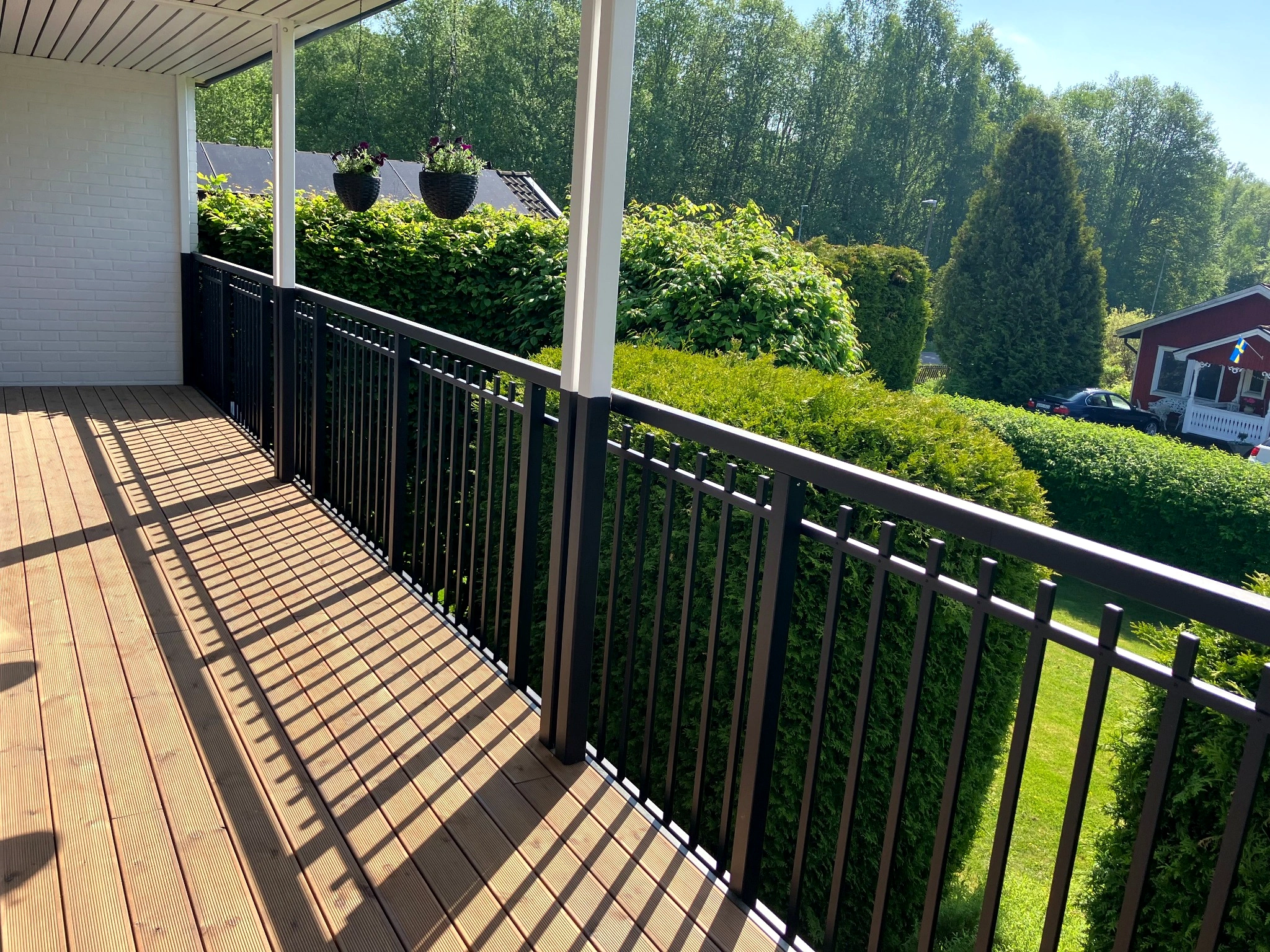
A wood-clad villa with a light-colored facade, darker panel accents, and an elevated balcony with a wooden deck. The view looks out over a lush garden with trimmed hedges and greenery extending toward the neighboring properties. It is a place with a serene character—but where the balcony previously lacked a distinct character. The railing needed to do more than just meet the safety requirements for a raised outdoor space: it was meant to give the balcony its own identity while also tying in with the house’s facade.
The balcony railing, in particular, is one of the most visible features of a house. It’s visible from the street, from the garden, and from the neighbors all around. A railing chosen carelessly detracts from the appearance of the entire facade. A railing chosen wisely enhances the entire house.
The Solution: Retro wrought-iron railing in black textured paint
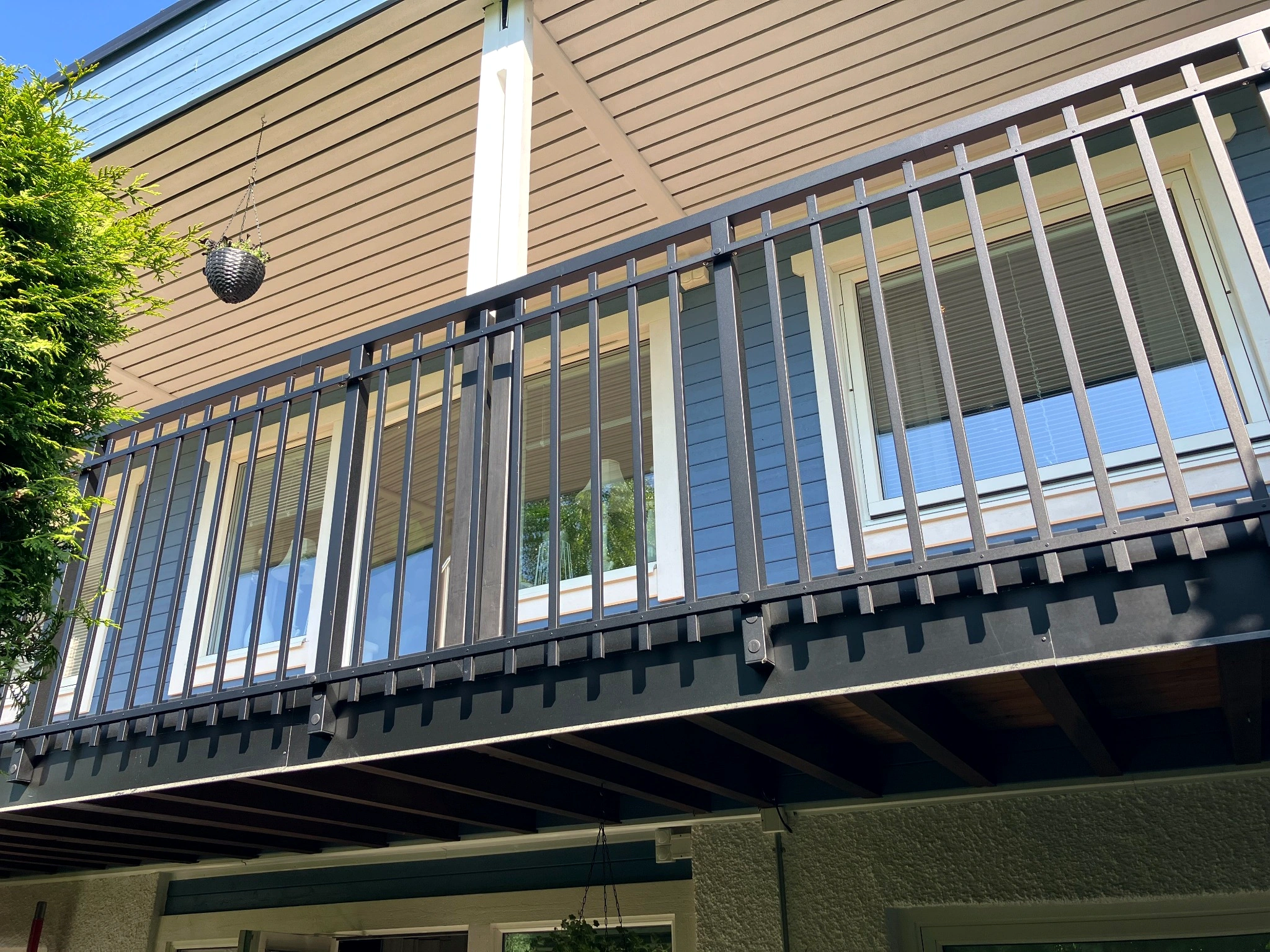
We chose Retro, our powder-coated aluminum wrought-iron railing with a classic slat design. The railing is finished in black textured paint—a matte surface that absorbs light without reflecting it. The classic, vertical slat design with intermediate and top rails gives the railing the well-balanced rhythm characteristic of older wrought-iron railings, but in a material that doesn’t require the maintenance that genuine wrought iron would have required.
Black is a flattering color against a wooden facade: it clearly frames the balcony without competing with the facade’s own tone for attention. Against the warm wood, the black railing creates a calm, graphic contrast—timeless rather than trendy.
Outdoor aluminum wrought-iron railing—the classic look without the maintenance
Wrought-iron railings are part of a long Swedish architectural tradition—from turn-of-the-century buildings to rural villas and the balconies of functionalist architecture. The problem with genuine wrought iron is that it requires ongoing maintenance: rust treatment, repainting, and inspection of fasteners that begin to corrode where the paint has peeled off.
Retro solves that equation. The railing has the design and proportions of a wrought-iron railing, but is made of powder-coated aluminum. It doesn’t rust. The finish doesn’t peel. It never needs to be repainted. The classic look remains—but the work involved in maintaining it does not.
Choose a textured finish (textured lacquer or matte finish) over a glossy finish. Matte black hides minor scratches and marks better and retains its appearance for decades. Glossy surfaces show every fingerprint and sign of wear more clearly.
Wrought-iron railing, aluminum railing, or glass railing for the balcony?
There are a few different types of balcony railings that are popular in Sweden today. The choice depends on the style of the house, the atmosphere you want to create, and how much of the view and natural light you want to preserve.
| Railing Type | Feeling | Visibility & Light | Best suited for |
|---|---|---|---|
| Wrought-Iron Railing (Retro) | Classic, timeless | Partially open | Wooden facade, single-family home, classic house |
| Wire Railing | Modern, minimalist | Maximum transparency | Modern house, view |
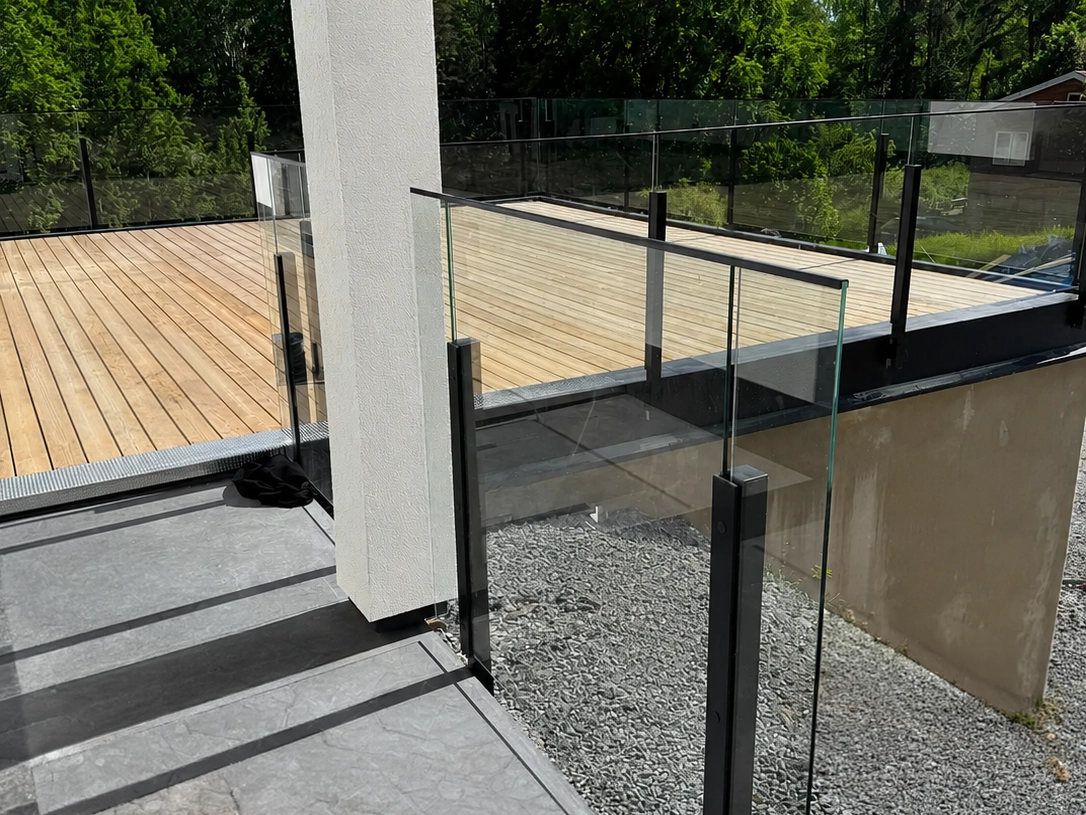
| Glass railing | Light, contemporary | Completely open | Lake view, south-facing balcony |
| Aluminum railing | Stylish, neutral | Partially open | A modern house without a view to make the most of |
Balcony railing height, balusters, and the Swedish National Board of Housing, Building and Planning's building codes
Balcony railings are subject to the Swedish National Board of Housing, Building and Planning’s building regulations (BBR). If the fall height exceeds 1.0 meter—which is the case for most balconies—the railing must be at least 1,100 mm high. The openings between the railings must not exceed 100 mm to prevent a child’s head from getting stuck. These regulations apply to all balconies, both in new construction and during renovation.
In this project, the railing is mounted at a height of 1,100 mm, attached to the outside of the balcony edge—the classic method for installing wrought-iron-style balcony railings. This leaves the entire balcony floor free for furniture and plants, and gives the railing its characteristic projecting line when viewed from the side.
Plan Your Balcony Railing—Here's How, Step by Step
- Measure the edge of the balcony carefully: Take into account corners, any posts, and whether the railing will go around one side or more. Custom sizes cost nothing extra with us—everything is made to measure.
- Choose a color based on the exterior: Black for wood exteriors and light-colored stucco, white for dark-colored houses, and anthracite for modern exteriors. The entire RAL color scale is available as standard.
- Decide on the design: classic railings, more modern aluminum railings, or completely open (glass). Consider how the balcony will look from both the inside and the outside.
- Choose a mounting option: Surface mounting leaves the floor area unobstructed and creates a classic look. Deck-mounted installation is more modern but takes up a little space inward.
- Check the drop height and height requirements specified by Boverket before placing your order.
Inspiration for those planning a balcony railing
- How does the railing complement the facade? A black railing works well with almost any wood or stucco facade. White railings are best suited for darker houses where contrast is needed. The railing should either blend in or create a deliberate contrast—rarely anything in between.
- Classic or modern design? Slats in a wrought-iron railing create a timeless, classic look that ages beautifully. A wire or glass railing offers a more modern, minimalist look. Both work—but they convey different styles.
- How is the balcony installed? The way the railing is mounted—on the outside of the balcony edge or mounted on top of the deck—affects both the appearance and how much of the balcony floor you can use. Exterior mounting is the classic approach and frees up more space on the deck.
A balcony railing that enhances the entire house
This project shows that a balcony railing is not just a safety feature—it’s one of the home’s most visible architectural choices. With the Retro model in black, the balcony takes on a look that fits equally well on a classic villa and a more modern wooden house. The railing doesn’t draw attention to itself, but it changes how the entire facade is perceived. The railing isn’t meant to be the star of the show—it’s meant to enhance the rest of the house.