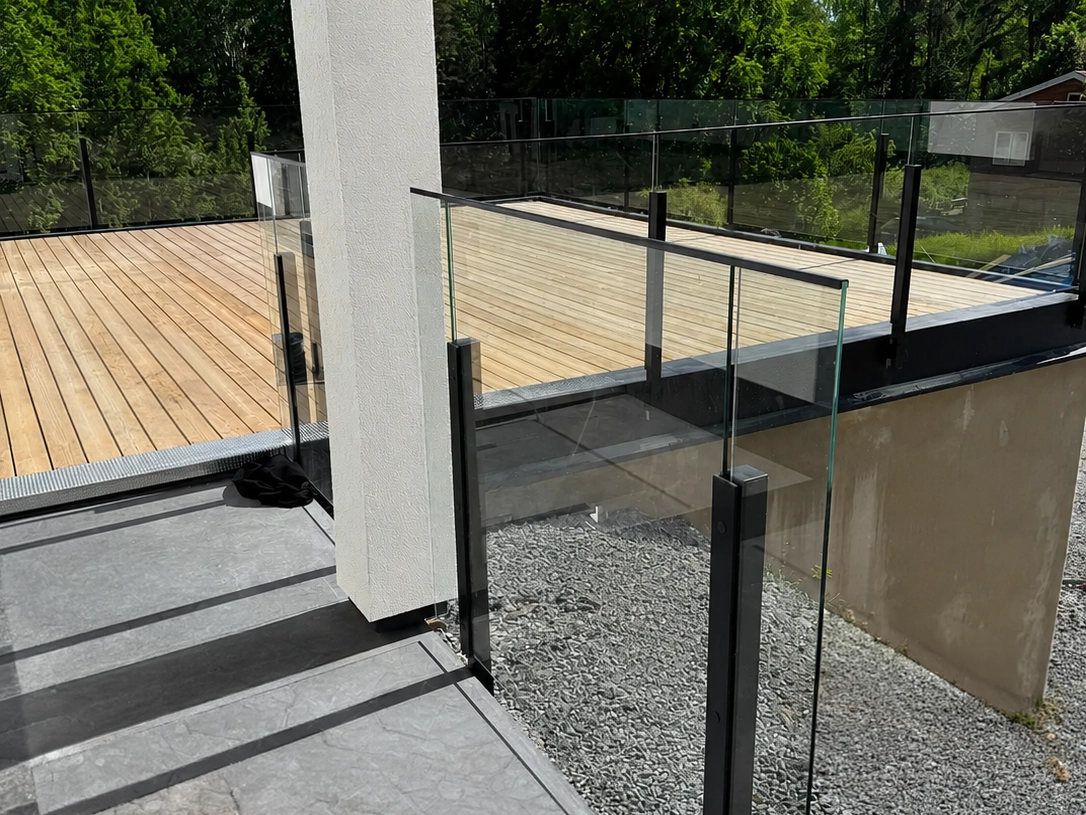
A railing that works on a detached house’s patio isn’t automatically suitable for a stairwell, even if it looks the same.
The difference lies in what the entire structure is certified for. That is the information summarized by Räckesbutiken’s service class.
The application class is our own indication of where a particular railing configuration is suitable for installation. It is based on applicable requirements, the product's design, and our own tests.

The class answers a question you'd otherwise have to guess
The "Application Class" is Räckesbutiken's own indication of where a particular railing configuration is suitable for installation. This assessment is based on applicable requirements, the railing's design, and our own product tests.
Where should the railing be placed?
A private balcony, a shared stairwell, and a public terrace are subject to different uses and loads.
How is the railing constructed?
Height, section width, and selected details affect the load for which the finished structure is verified.
The class is displayed immediately
The configurator links the usage class to the combination you're building and updates it when your selections change.
Instead, you'll see a clear indication specific to the exact railing configuration you're working with. This makes it easier to see if your choices are suitable for the intended location.
The Four Classes
This class summarizes the line load for which the current handrail configuration has been verified and the types of environments in which it is typically suitable.
| Class | Line load | Suitable for |
|---|---|---|
| A+ | At least 1 kN/m | All residential settings, as well as public spaces such as offices, restaurants, and stores. |
| A | At least 0.5 kN/m | All types of residential environments. |
| B | At least 0.5 kN/m | Environments with a limited elevation difference. |
| C | Untested configuration | Ground level. |
One kilonewton per meter is roughly equivalent to 100 kilograms per running meter.
In areas where there is more foot traffic or where congestion may occur, the higher railing is required, even if it looks the same.
The class changes when you change
The application class is not tied solely to the product model. It applies to the complete configuration you build, where height, section width, mounting, and component selection all work together.
Railing height
A taller post provides a longer lever arm. With the same force, this can result in greater torque on the post and the mounting.
Section width
A longer span between the posts means that each section and attachment point must bear a greater portion of the load.
Details and Mounting
Installation methods, post types, and other design choices can affect how the load is transferred to the load-bearing foundation.
The tests behind
The safety of our railings is based on tests of the entire structure and on materials that are tailored to the railing's location.
Impact tests on glass railings
For our glass railings, we conduct impact tests in accordance with the regulations of the Nordic Balcony Association, among other things. These tests are designed to ensure that the structure can withstand the stresses that may arise in real-world environments.
See the Balcony Association's technical documentsSafety glass in glass railings
Where the railing includes glass, safety glass is used that is tailored to the design and location. This reduces the risk of injury if the glass is subjected to a strong impact.
Read about safety glass for railingsThe tests apply to the entire range
The test results are used to determine the performance class for which the finished railing configuration has been verified. Therefore, the performance class applies to the entire structure, not to an individual post, glass panel, or fastener.
Read about our safety testsFind the Right Railing for Your Space
Browse our complete selection or contact customer service for assistance with usage class, placement, and choosing a railing.
Where you see the class
The application class tracks the current railing configuration from design through ordering. You can therefore verify it both while you are building the railing and in the documentation afterward.
Below the 3D image
The class appears as an icon below the 3D image and updates as you change the height, section width, attachment, or other settings.
In the quote and order email
The usage class is also specified in the email, so you have this information in writing in case a client, inspector, or association asks about it later.
Only complete railings
The class applies to the entire structure. Individual glass panels, fittings, and handrails are therefore not assigned their own service class.
When Class Matters Most
The utility class is valuable regardless of who places the order, but its significance varies depending on where the railing will be installed and who needs to be able to verify the selection.
Confidence in the Choice
For a homeowner, the classification makes it easier to determine whether a railing is suitable for, say, a patio, balcony, or staircase, without having to assess the structure's load-bearing capacity on their own.
A portfolio to showcase
For a condominium association, developer, or architect, the classification becomes part of the documentation demonstrating that the design has been selected for the appropriate use.
Order the documentation from the beginning
If the railing is to be installed in a stairwell, on a shared terrace, or in a public setting, the service class and related documentation should be included in the files.
It is easier to ensure the correct grade and request the supporting documentation when placing the order than to try to gather everything before a final inspection.
How to Check the Service Class—Step by Step
Start by selecting the environment where the railing will be installed, and then check how your choices affect the class in the configurator.
-
Decide how the space will be used
Start by determining whether the railing will be installed in a private residence, a common area, or a location open to the public.
-
Take into account how many people are there
In a stairwell, on a shared terrace, or in a public setting, the railing must be able to withstand the weight of multiple people at the same time.
-
Build the railing in the configurator
Enter the dimensions and select the railing height, section widths, mounting method, and other details for the specific location.
-
Check the icon below the 3D image
The usage class for the current configuration is displayed there. Check it again after you've made a change.
-
Adjust if you need a higher grade
Change one thing at a time. For example, a narrower section width can improve conditions without requiring you to replace the guardrail system.
-
Save the quote
When you save the configuration, the service class information is included in the quote or order email.
-
Request documentation when the project requires it
For a housing cooperative, developer, or other project client, the relevant documentation should be obtained and saved along with other documents.

Frequently Asked Questions About Service Classes
Here you'll find brief answers about the meaning of the classes, where they appear, and why they may change when the railing's design is adjusted.
What is a wear class?
The usage class is Räckesbutiken’s indication of where a railing is suitable for installation. It is based on current building codes and our own product tests.
What is the difference between Class A and A+?
The difference lies in the load-bearing capacity. Class A is certified for at least 0.5 kN/m, and Class A+ for at least 1 kN/m. The higher class is used in public settings where multiple people may apply force to the railing at the same time.
What does kN/m mean?
kN/m stands for kilonewton per meter and describes the force along the top edge of the railing. One kN/m is roughly equivalent to 100 kilograms per running meter.
Why does the class change when I change the railing height?
A taller post provides a longer lever arm and can therefore generate greater torque in the post and the mounting bracket under the same load. The class is determined based on the entire configuration in question.
What does Class C mean?
Class C means that the configuration deviates from the tested standard. It has therefore not been verified in the same way, and the same documentation cannot be provided for the design.
Where can I see the usage class?
The class is displayed as an icon below the 3D image in the configurator. It also appears in the quote or order email when you save or order the railing.
Are all products assigned a service class?
No. The performance class applies to complete railings. Individual glass panels, handrails, fittings, and other loose components do not have their own class.