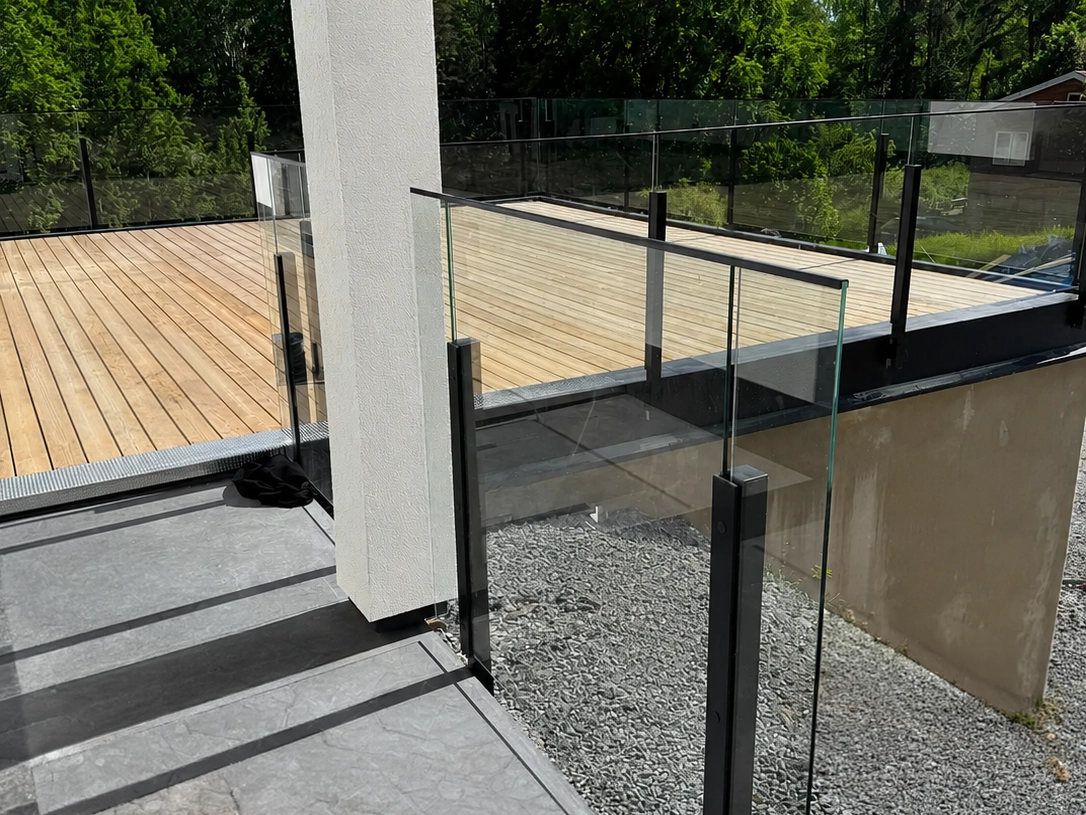
A small balcony is often used more than a large one. That's where morning coffee becomes a habit, precisely because it's close by and easy to step out onto.
But small spaces are more sensitive. A railing that’s barely noticeable on a large terrace can cut the sense of space on a six-square-meter patio in half.
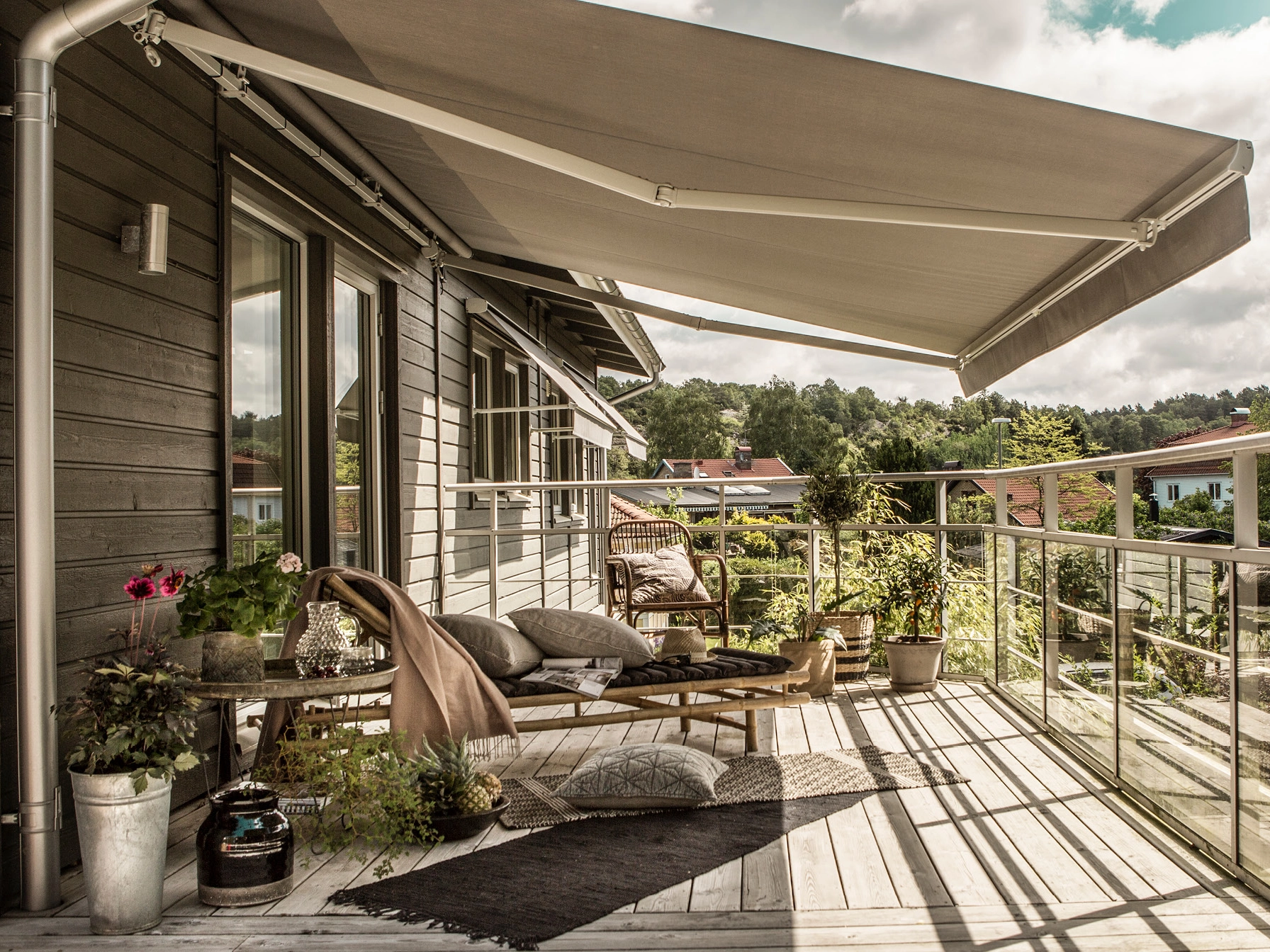
The railing has two types of finish
With a small balcony, it's not just about how many centimeters the railing takes up. It affects both the actual floor space and how spacious the area feels.
What Actually Takes Up Space
A post standing on top of the deck takes up a few centimeters, and it does so along the entire edge—exactly where you’d most like to be able to slide a chair in or use that last bit of floor space.
What Catches the Eye
A solid railing draws the eye to the edge, making the balcony seem to end there. A railing that allows the view to pass through lets the space visually extend out into the garden.
Solutions with Low Visual Impact
On a small balcony, the difference between various types of railings is immediately apparent. The less the railing obstructs the line of sight, the more the garden and the surroundings become part of the experience.
| Solution | Visual weight | Comment |
|---|---|---|
| Post-free glass railing | Lowest | No interrupted lines at all, but the most expensive. |
| Glass with slender mullions | Low | A good balance between price and visibility. |
| Wire Railing | Low | Not where children under six are present. |
| Vertical slats with a narrow profile | Average | Safe, affordable, and discreet from a distance. |
| Dense picket fence | Highest | Blocks the view—choose this option primarily when visibility is an issue. |
If you choose a solid railing for privacy reasons, you’ll get the privacy you want but lose some space in the process. On a small balcony, it’s rarely worth installing it all around the perimeter—however, a solid railing on one side might be exactly what you need.
Color does more than you think
The color doesn't just affect how well the railing complements the house. On a small balcony, it also determines how clearly the railing is perceived as a boundary around the space.
Dark and dull
A dark railing blends in more easily with greenery and a dark facade. This allows the eye to pass right through the railing, making the patio feel more connected to the garden.
Light or contrasting
A lighter-colored railing stands out more clearly against the same background and serves more as a frame around the patio. This works well when you want the patio to feel like a separate room.
In such cases, a color that is close to the shade of the facade usually creates the most understated look and makes the railing appear less prominent.
Furniture Against the Railing
On a small patio, the furniture is almost always placed close to the edge. This means that details that are barely noticeable on a larger patio play a much more significant role.
-
Straight interior Provides more usable floor space
- A chair that is meant to be pushed up against the railing needs clear space at the bottom. A bottom rail, a profiled foot, or another protruding feature may require the chair to be placed several centimeters further back on the patio.
-
What's next to it Be aware of the risk of falling
- A flower box, stool, or other piece of furniture next to the railing can serve as a step. In a small space, objects naturally end up closer to the edge, so their placement needs to be considered in relation to the railing.
A straight and unobstructed interior makes it easier to use the entire floor space without having to move chairs and tables further in than necessary.
What the Rules Require
For a balcony, it is no longer a single measurement that determines whether a railing is needed. Instead, the assessment is based on the risk of injury in the event of a fall.
-
01When is protection needed? Assess the risk of falling
- Fall protection must be provided where there is a particular risk of personal injury. A specific general fall height that automatically triggers the requirement for guardrails is no longer specified.
-
02How high should it be? No fixed minimum height
- The guardrail must be of a height and design that minimizes the risk, taking into account how the surface is used and the height of the fall.
-
03When younger children are present Special requirements apply
- In areas where children under the age of six may be expected to be present without constant supervision, there are also specific requirements regarding, among other things, openings and the ability to climb.
A deck that is twenty centimeters above a lawn does not pose the same risk as a deck that is one meter above a paved driveway. The surface and the consequences of a fall are part of the assessment.
Here's how to do it—step by step
Start by considering how the balcony will actually be used. When you’ve thought through the furniture layout, mounting, and sight lines, it becomes much easier to choose the right railing.
-
Measure the area and arrange the furniture
Draw in where the table, chairs, and other furniture will actually go. On a small balcony, the railing needs to be planned along with the furniture layout.
-
Choose side mounting if possible
If the edge beam allows it, the posts can be mounted on the outside. This moves the railing structure away from the floor surface itself.
-
Check the line of sight while seated
Sit in the chair you'll be using and see where your gaze falls. On a small balcony, the view from a seated position is often more important than the view when you're standing.
-
Choose a filling based on texture
Start by considering how open you want the railing to feel. Glass and other visually light solutions often make the biggest difference when space is limited.
-
Decide whether the railing should be visible or hidden
Choose a color based on whether you want the balcony to be framed as a separate space or to blend visually with the facade and the garden.
-
Check the inside of the railing
A straight interior without a protruding foot or bottom rail makes it easier to push furniture all the way to the edge.
-
Review climbable features
If children are on the balcony, both the design of the railing and any objects placed near the edge must be evaluated from a climbing safety perspective.
A small space that needs to feel bigger?
Send us the measurements and a photo, and our customer service team will suggest a solution that takes up as little space as possible. Everything is custom-made in Ängelholm, down to the millimeter.
Frequently Asked Questions About Railings for Small Patios
Which railing is best suited for a small balcony?
What lets the view through. Glass provides the most sense of space, while narrow-profile vertical slats are the affordable compromise.
How can I maximize my floor space?
Side mounting. The posts are positioned outside the deck instead of on it, giving you the full width of the railing.
Does color make a difference?
Yes. A dark, matte railing blends into the greenery and the building’s facade, while a light-colored one creates a visible frame around the surface.
Is a pillarless design worth the extra cost?
In a small space with a view, often yes, since posts obstruct an already limited view. On a private patio, rarely. Read more about post-free railings .
Can I install a wire railing?
Only in areas where children under six are not allowed to be without supervision. Horizontal cables provide a foothold in the lower zone. Read more about safety and cable railings .
What should the height of the railing be?
The regulations do not specify a minimum height. Choose based on the drop height and what is below.
What should I keep in mind when furnishing a room?
The inside of the rail is straight. A protruding foot or bottom rail prevents the chairs from sliding in.