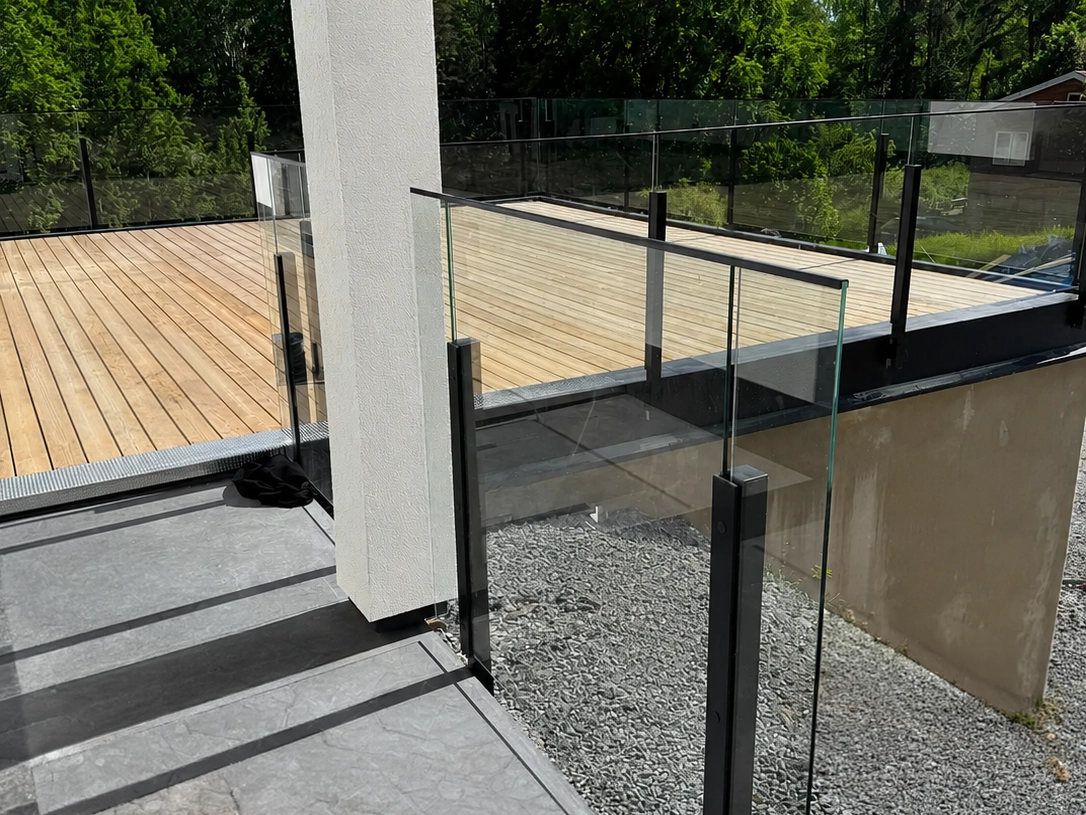
A child safety gate is designed to be clamped or screwed between two fixed surfaces. An open staircase often has neither.
That’s the whole problem, and it can be solved. But one of the solutions that’s often suggested shouldn’t be used at the top of a staircase. It’s important to know this before you order a gate or start building a mounting bracket.
This article focuses on how to create a secure anchor and permanent fall protection for an open staircase. The child safety gate itself is not included in Räckesbutiken's product lineup.

The gate is built for something you don't have
Stairs in an open-plan layout often lack both a wall and a railing on one side. Sometimes there is only an open edge of the floor joists where the stairs begin.
The gate's installation instructions, however, require two fixed mounting points and a specific distance between them. If one of the points is missing, a load-bearing mounting point must be created before the gate is installed.
A custom solution that deviates from the manufacturer's instructions also means that you cannot assume that the gate's certified safety features or any warranty will apply to the installation.
What the gate needs to be able to handle
Child safety gates are covered by SS-EN 1930:2011, which specifies safety requirements and test methods for gates that restrict children's access to certain areas of the home.
However, the gate's labeling alone is not sufficient. It must also be properly installed for the specific staircase and used in accordance with the manufacturer's instructions.
Safety requirements and test methods for child safety gates intended for indoor use.
The gate should not open out over the stairs
At the top of the stairs, the gate should open away from the stairs. Otherwise, the child could end up next to or on the top step when the gate swings open.
The design should not encourage climbing
Make sure the child cannot climb over, under, or through the gate. Horizontal bars at the bottom can serve as footholds and make it easier to climb the gate.
When the railing is the easier way
If the staircase does not have a handrail, the same design can serve both as a mounting for the gate and as a permanent fall protection system.
Provides the gate with a secure anchor point
The gate can be mounted on a sturdy post instead of a temporary solution at the stairwell opening.
Permanently protects the open side of the staircase
The rail remains in place even after the child has outgrown the gate and continues to reduce the risk of falling from the side.
Doesn't have to block the room's lines of sight
Vertical balusters with a slim profile or made of glass can provide fall protection without making the staircase look bulky.
In a stair floor structure, it is often the stringer, a edge beam, or the reinforced edge of the floor structure that is designed to bear the load. Drywall, sheathing, and a floor panel alone are not sufficient.
Avoid temporary solutions
A guardrail on an open staircase must be securely anchored and able to withstand a child pushing, pulling, or climbing against it. Items that merely look like a barrier do not provide the same level of protection.
- Rep
- It does not provide a solid barrier and does not prevent a child from crawling under, over, or past the barrier.
- Net
- It may give way when a child leans against it and is not a substitute for a gate or railing that is anchored to the structure.
- Trellis
- It is often used as a decorative room divider and is not designed to serve as a fall protection barrier. Horizontal sections can also be used as climbing rungs.
- Bookshelf
- A piece of furniture is not a secure anchor point. It can be moved or tip over, and at the same time makes it harder to see what’s happening near the stairs.
- Loose furniture
- Chairs, benches, and storage furniture can be moved and used for climbing. They should not be used to block a stairwell.
When an opening appears to be blocked off, it’s easy to reduce visibility—even though the solution can’t withstand the load. Use a gate installed according to the manufacturer’s instructions, and supplement the open side with a proper railing.
Here's how to do it—step by step
Start by determining the location and the supporting structure before choosing a gate. This will make it clear what kind of installation is required and whether a railing needs to be built at the same time.
- Decide whether the gate should be installed at the top or bottom of the stairs. The location determines which type of mounting can be used.
- Choose a screw-mounted gate if it is to be installed at the top. Do not use a clamp-on gate in that location.
- Find out what is load-bearing on both sides of the opening—not just what looks stable.
- Check the direction of opening. The gate should not be able to swing out over the stairs.
- Measure the opening at several heights. Walls, posts, and floor joist edges are not always parallel.
- Check the bottom part of the gate and avoid designs that a child could use as a ladder.
- If you need to build a fixed anchor point at the stairwell anyway, consider installing a proper railing right away.
Does the staircase lack a mounting point for the gate?
Check out our custom-sized stair railings or send a photo of your stairs and the opening to customer service. We can then help you determine which railing solution provides both a secure mounting point and permanent fall protection.
Frequently Asked Questions About Stair Gates
Here are some brief answers about installation, placement, and how to combine a child safety gate with a permanent railing.
Can you install a baby gate without a railing?
Yes, but a fixed anchor point must be created. Common solutions include a post anchored to the load-bearing floor structure or a narrow railing to which the gate can be mounted.
Is it possible to install the gate without drilling?
At the bottom of the stairs, a clamp-on gate may be used if the manufacturer’s instructions permit it. At the top of the stairs, you should use a gate that is designed for that location and is screwed into a load-bearing surface.
Why shouldn't a clamp gate be installed at the top?
It is held in place by pressure and friction against two surfaces. If the gate slides or comes loose when a child pushes against it or leans on it, there is an immediate risk of falling down the stairs.
What standard applies to child safety gates?
Child safety gates are covered by SS-EN 1930:2011, which specifies safety requirements and test methods. Always follow the labeling and installation instructions for the specific gate.
How long will the baby gate be needed?
Many models are designed for children up to about 24 months of age. The gate should be removed sooner if the child can climb over it, open the latch, or loosen the mounting. Always follow the manufacturer’s age limit.
Can the gate be mounted on drywall?
No, not just in the drywall. The screws must reach a stud, a rafter, an edge beam, or some other load-bearing structural member that can support the load.
Is a railing better than a gate?
They solve different problems. The railing provides permanent fall protection along the open side of the staircase, while the gate temporarily prevents a child from using the stairs. In an open staircase, therefore, both are often needed.