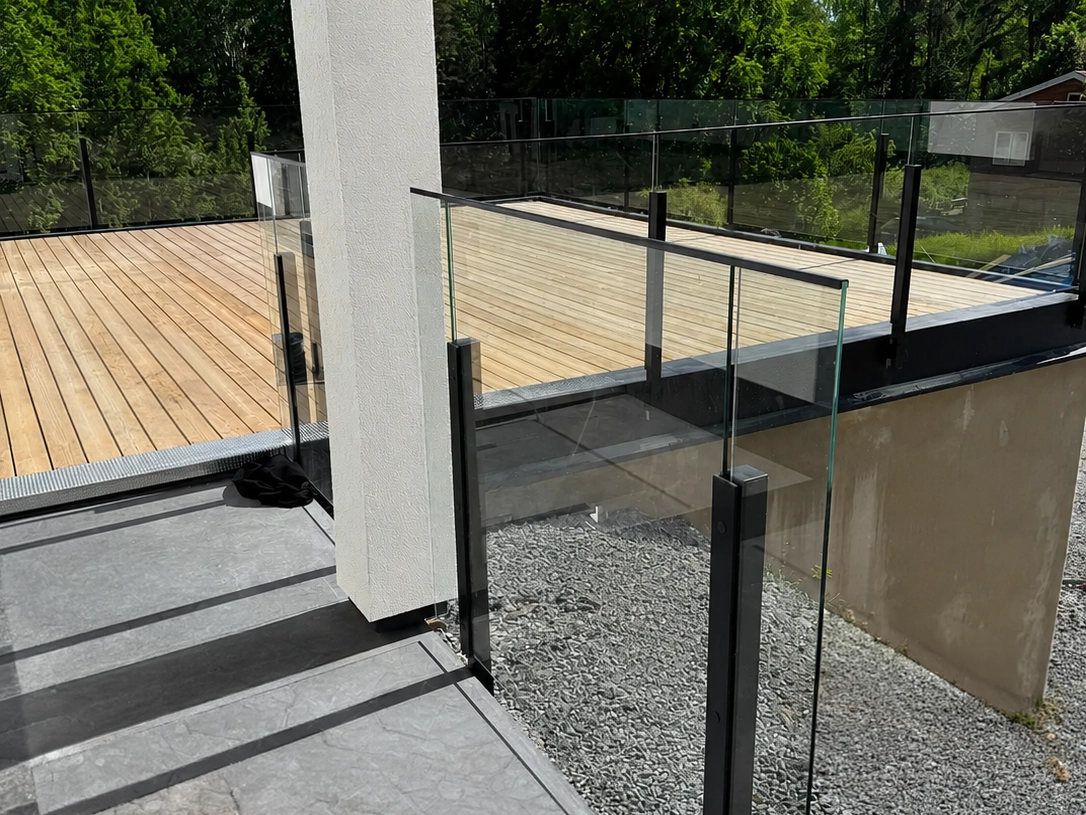
A railing is only as strong as the surface it’s mounted on. That’s the most important principle to keep in mind when choosing a mounting system.
Wood is the most common surface among our customers, and all glass railings come with screws for mounting on wood. For concrete, stone, brick, steel, lightweight concrete, and other surfaces, however, the mounting hardware must be selected separately.
So it’s not enough to simply choose a strong screw. The fastener must be compatible with the material behind the railing post or base and be able to transfer the load to a load-bearing part of the structure.
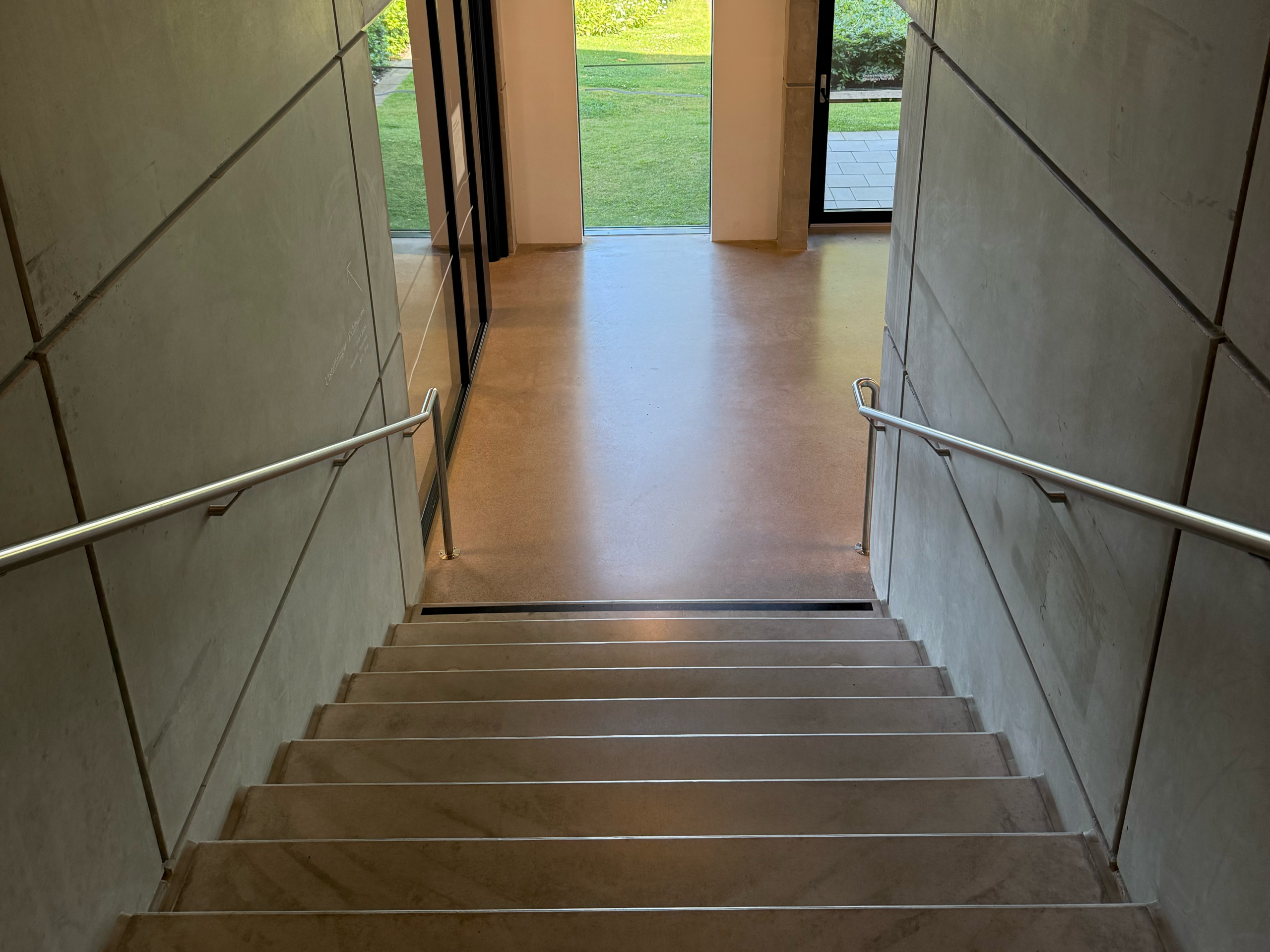
It's the base that matters, not the screw
The same post, the same foot, and the same load may require completely different mounting solutions depending on the material in which the railing is to be installed.
The difference is not primarily a matter of how strong the material appears to be, but rather how it behaves around the drill hole when the fastener is under load.
- Solid concrete
- It normally distributes the force evenly around the drill hole, but the edge distance and any reinforcement must be taken into account.
- Hålsten
- It has air pockets beneath the surface, which means that a standard expanding plug may lack material to brace against.
- Lightweight Concrete
- It is porous and may crumble if the fastener is tightened too much or if the load is concentrated on a small area.
- Steel
- Usually requires threading or drilling so that the force is absorbed by the correct bolt, nut, and steel grade.
What Applies to Each Material
The fastening method should be selected based on the load-bearing surface. The table shows what typically works and the most important mistakes to avoid.
| Background Information | What Usually Works | Things to Watch Out For |
|---|---|---|
| Wood | Screw into a stud, stringers, or edge beam. | The fastener must never be secured solely to the deck board. |
| Solid concrete | Expansion anchors or chemical anchors. | Check the edge clearances and the placement of the rebar. |
| Perforated stone and brick | Chemical anchor with a mesh screen. | A standard plug can expand inside a cavity without gaining a grip. |
| Lightweight Concrete | Chemical anchor or fastener specifically designed for lightweight concrete. | The material may crumble if the fastener is tightened too much. |
| Steel | Through bolt or properly sized threaded hole. | Use the correct bolt grade and size—don't just use any bolt. |
| Drywall and Lightweight Partition Walls | Fastening to studs or to a load-bearing panel behind them. | The drywall itself should not support the railing or handrail. |
Solid concrete
When fastening to solid concrete, there are two common methods. The main difference lies in how the fastener exerts force on the concrete around the drill hole.
Always check the technical specifications of the fastener
The required edge distance, drilling depth, and spacing depend on the selected fastener, the dimensions, and the properties of the concrete. This information is provided in the manufacturer’s technical documentation and must be verified before drilling the holes.
Measurements You'll Need When Building a New Home
If you're building a new deck or pouring a new slab, it's a good idea to know the hole pattern for the railing posts in advance. That way, you can position the joists and rebar so that the fasteners are in the right place from the start.
- Aluminum base 80 mm
- The distance between the screw holes on the aluminum base is 80 millimeters.
- Stainless steel base 75 mm
- The distance between the screw holes on the stainless steel base is 75 millimeters.
- Practical Implications
- Position the board so that both screw holes are in load-bearing wood. A mounting where only one hole is securely fastened does not provide the same stability.
- During casting
- Plan the placement of the posts before laying the rebar. This reduces the risk of the drill holes ending up directly over the rebar.
Indoor handrail
A handrail may look simple, but it is a safety feature. The mounting must hold when someone grabs the handrail to prevent a fall.
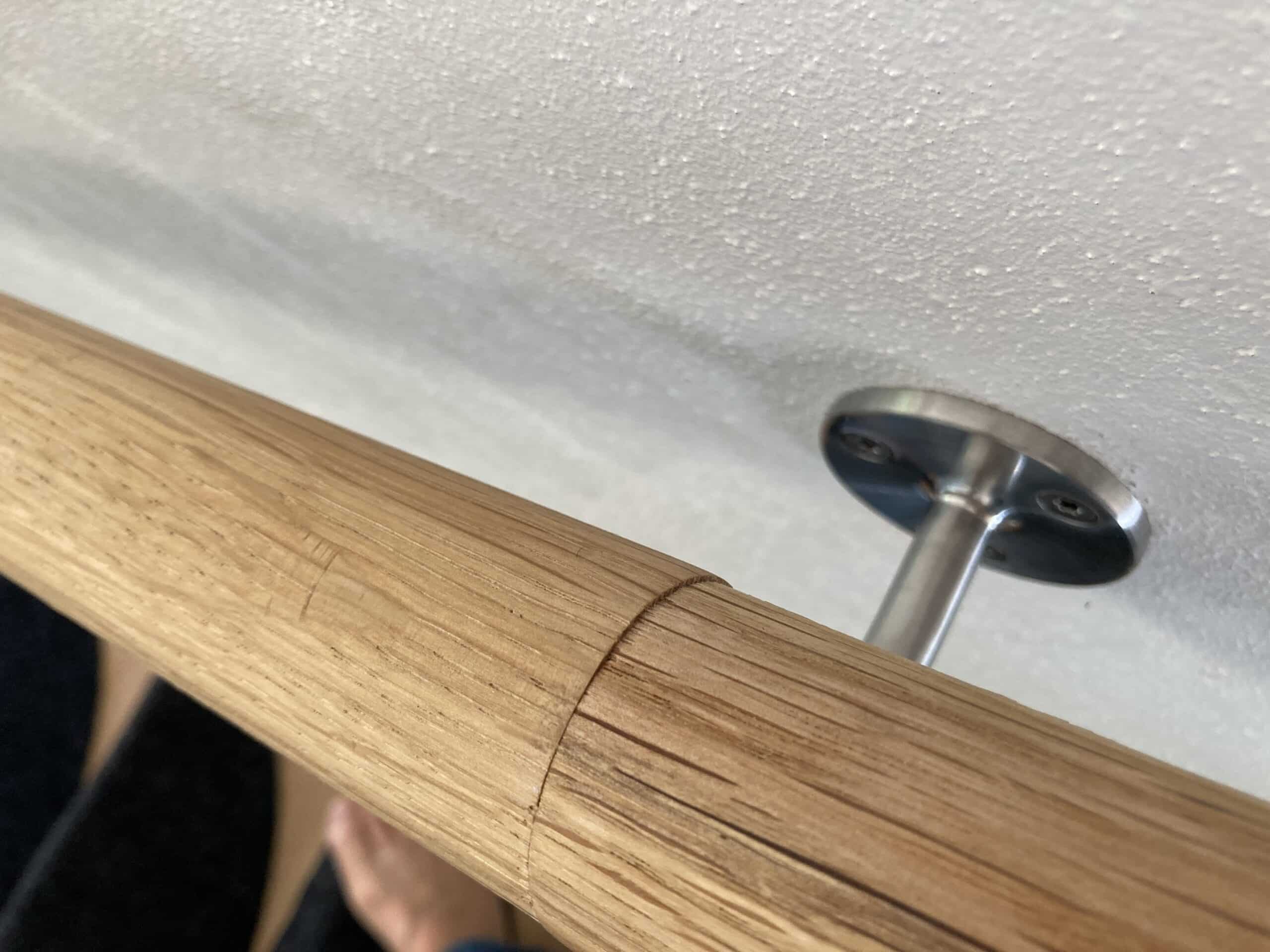
The brackets should be attached to the studs
The force is significantly greater when a person suddenly grips the handrail than when their hand simply slides along it. Therefore, each bracket must be anchored to a load-bearing part of the wall.
If the brackets cannot be placed where the studs are located, the solution is to first install a backing panel that spans several studs. The handrail brackets are then attached to the panel.
Plasterboard can serve as a surface layer but should not bear the load to which a handrail may be subjected.
Here's how to do it—step by step
Start by identifying the load-bearing substrate. Then select the fastener, its placement, and dimensions based on the material's properties and the fastener's technical documentation.
-
Find out what the substrate actually is
Don't base your assessment solely on what the surface appears to be. Behind plaster, paneling, or decking, there may be an entirely different load-bearing material.
-
Drill a test hole if you're unsure
The color and texture of the drill chips help you distinguish between, for example, solid concrete, brick, lightweight concrete, and other materials.
-
Choose the mounting method based on the surface
Do not use just any screw or anchor you happen to have at home. The fastener must be designed for both the material and the load to which the railing is subjected.
-
Check the edge clearance
Read the fastener's technical specifications before drilling the holes. The requirements vary depending on the type of anchor, its dimensions, and the quality of the substrate.
-
Sample a point
Install and apply a load to a fastener only when the substrate is old, masonry, or of unknown quality. Do not proceed with the rest of the work until the result has been evaluated.
-
Check the hole pattern
Make sure that all screw holes are drilled into load-bearing lumber and that their placement does not interfere with rebar, utilities, or an existing fastener.
-
Seek help if you're unsure about the load-bearing capacity
Have a structural engineer assess the foundation if its bearing capacity is unknown, damaged, or difficult to verify. A general rule of thumb cannot replace an assessment of the actual structure.
Not sure what type of mounting your surface requires?
Tell us what the railing will be mounted on, and our customer service team will go over the options with you and help you find a solution that works for your surface.
Everything is custom-made at our RISE-certified factory in Ängelholm.
Frequently Asked Questions About Mounting
Here you'll find brief answers about fastening into wood, concrete, hollow-core blocks, lightweight concrete, steel, and drywall.
Which screw comes with the railing?
Screw for fastening to wood, since wood is the most common surface. For other materials, you'll need to choose a fastener based on the surface.
How do you attach a railing to solid concrete?
With expansion anchors or chemical anchors. Chemical anchors are more commonly used near edges and in substrates of uncertain quality.
What are the rules for aerated concrete or lightweight concrete?
Chemical anchors are typically used, and in hollow blocks, they are supplemented with a mesh screen. A standard anchor plug may expand within the cavity without providing sufficient grip.
Can I attach a handrail to drywall?
No. The fastener must be secured to a stud or a supporting panel behind it that spans multiple studs.
What is the difference between an expansion anchor and a chemical anchor?
The expansion anchor presses outward against the walls of the drill hole, while the chemical anchor is bonded in place. For this reason, chemical anchors can often be used with shorter edge distances.
What is the hole spacing of the railing feet?
The distance between the screw holes is 80 millimeters on the aluminum base and 75 millimeters on the stainless steel base. It’s good to know this when planning the framework or reinforcement.
How do I know if the mounting is secure?
Test-install one mounting point before installing the rest. If the load-bearing capacity is uncertain, a structural engineer should evaluate the substrate and the mounting.